
How to Make Yourself Squirt: 6 Pelvic Floor Exercises That Actually Help
Oct 29, 2026Yes. It is possible.
No. It isn’t just an accidental thing that happens under the EXACT right circumstances.
If you’ve ever googled how to make yourself squirt, you’ve probably come across plenty of articles describing squirting as a rare, mythical occurrence reserved for a select few, or a pure accident that happens when the stars align.
The good news is, that’s not the whole story!
There’s a lot of anatomy, awareness, and pelvic floor training behind squirting. (We know that sounds like a slightly creepy science fair experiment, but trust us, it’s much more fun than that.)
Squirting isn’t a random fluke. It’s a body response shaped by arousal, blood flow, your glands and your bladder, and, we believe, pelvic floor coordination.
And here’s the twist: strength alone won’t cut it.
You can do hundreds of standard Kegels a day, but if your pelvic floor is overly tight (hypertonic) or lacks fine control, your body will instinctively clench and hold everything in just as pleasure peaks.
That’s where Pompoir comes in: a form of pelvic floor training built on precise movement, coordination and, crucially, release. Not every woman squirts, and that’s completely fine. But training the right way can help stack the odds in your favour.
So let’s get into it! (Pun intended.)
What Is Squirting, Really? (Squirting vs. Female Ejaculation)
Before we jump into the exercises, let’s clear up what’s actually happening when you squirt, because there’s a LOT of confusion online.
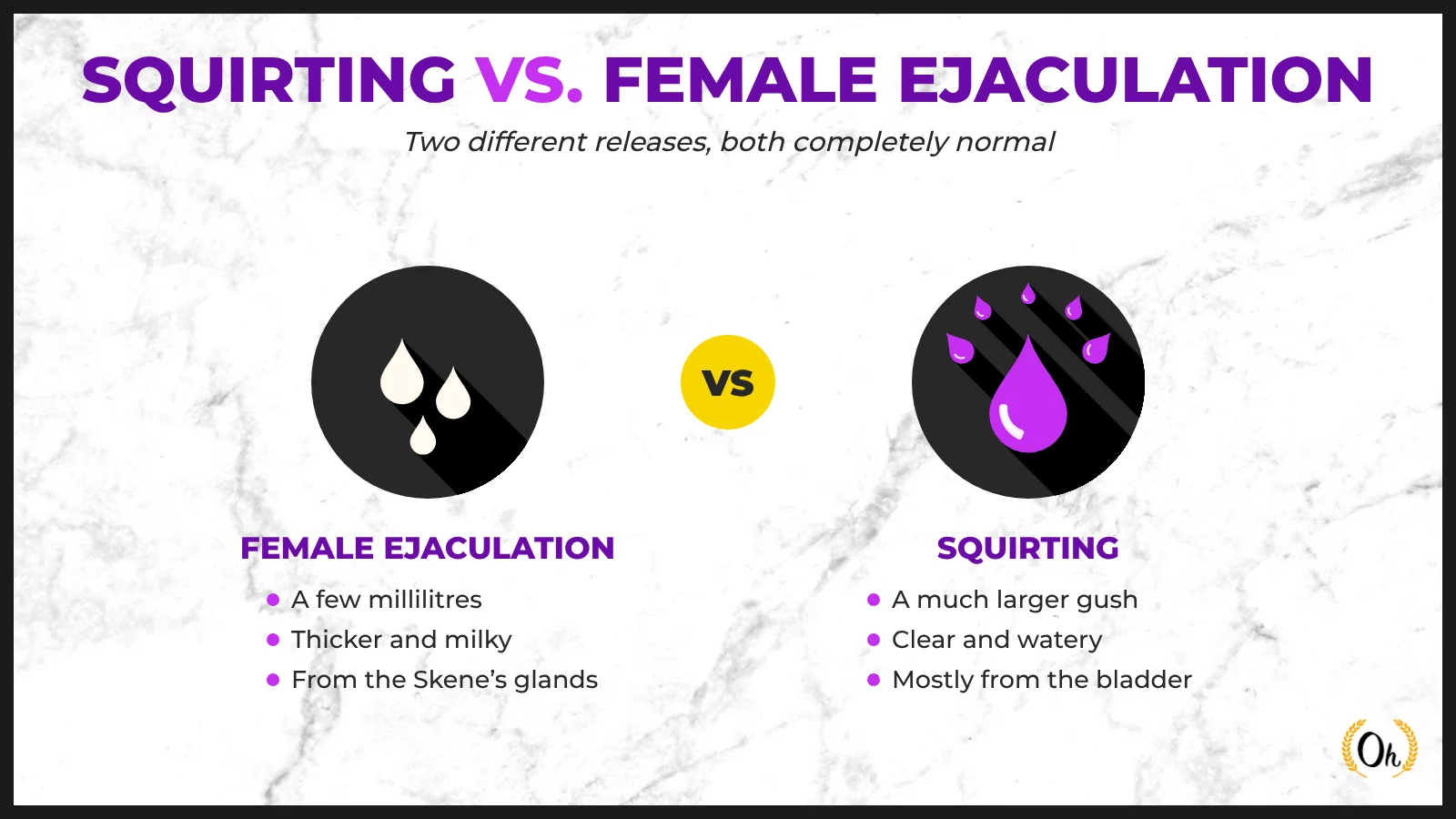
There are actually two different things that often get lumped together:
- Female ejaculation: a small amount (a few millilitres) of thicker, milky fluid released from the Skene’s glands during arousal or orgasm.
- Squirting: a much larger gush of clear, watery fluid, and this one mostly comes from the bladder.
Yep, you read that right. In a small but often-quoted study, researchers scanned women’s bladders before and after squirting. Their bladders filled up during arousal and were empty right afterwards, and the fluid was chemically very similar to urine, often with a small amount of Skene’s gland secretion mixed in (it showed up in 5 of the 7 women tested) (Salama et al., 2015).
Before you panic: this is completely normal. Yes, the fluid mostly comes from your bladder, but squirting is a normal part of some people’s arousal response, not a bladder problem, and absolutely nothing to be embarrassed about. Your body is simply doing something amazing that it rarely gets credit for. (And it’s exactly why the hydration and bathroom tips later in this article work.)
1. The Skene’s Glands (The Female Prostate)
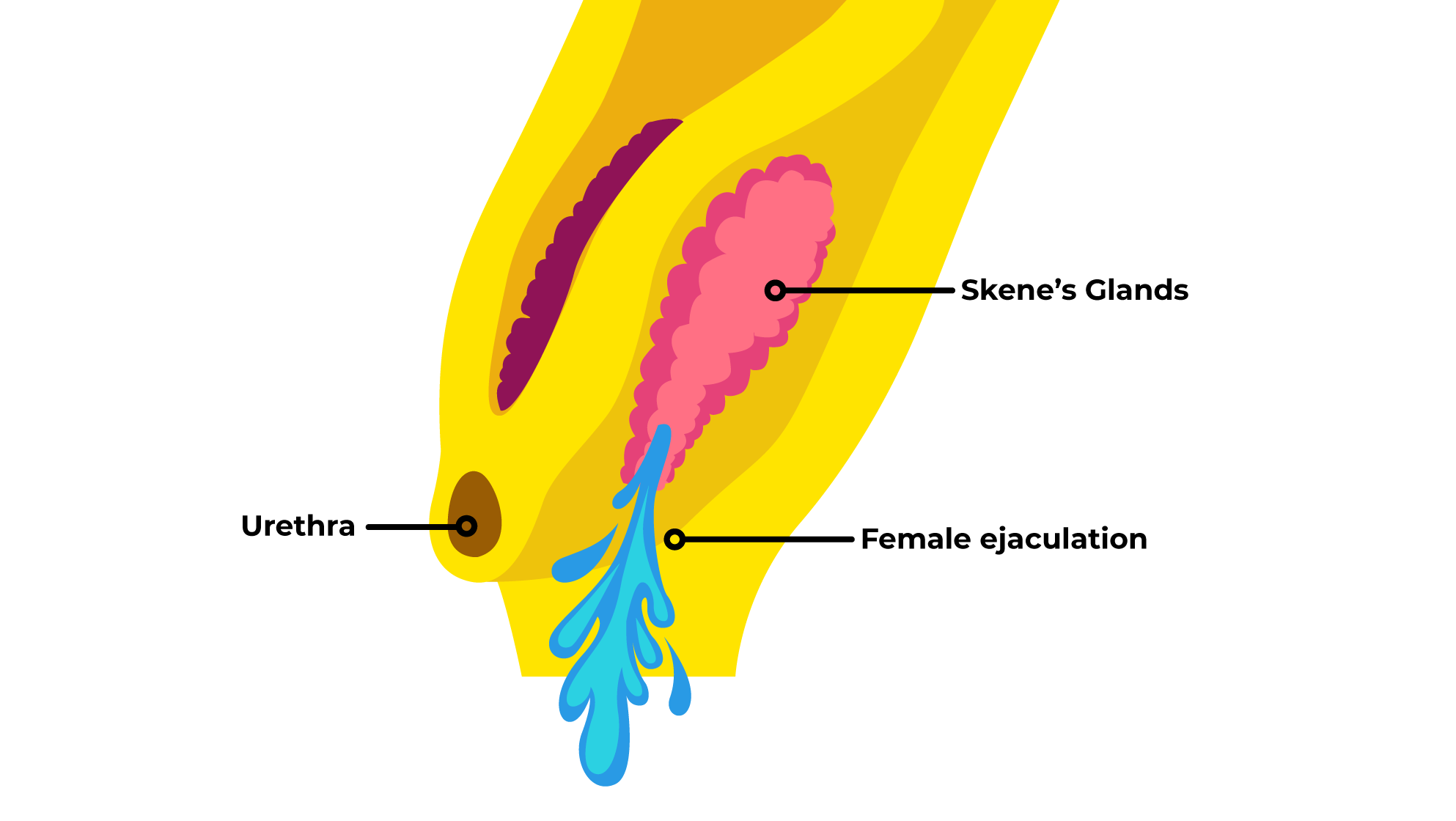
The Skene’s glands (often called the female prostate) sit on the front wall of the vagina, around the lower end of the urethra. They produce the small amount of milky fluid involved in female ejaculation, which contains prostate-specific antigen (PSA), the same marker found in male prostate fluid.
During squirting, a little of this fluid often mixes in with the larger release from the bladder.
2. The G-Spot and the Clitoral Complex
The “G-spot” probably isn’t an isolated magic button. Many researchers believe it’s an area on the front wall of the vagina where the internal parts of the clitoris, the urethra and the Skene’s glands all sit close together.
When you’re aroused, blood rushes into this spongy tissue and it swells. Rhythmic pressure against the front vaginal wall stimulates the whole area at once, which is why it’s so closely linked to squirting.
3. The Dual Role of the Pelvic Floor
Here’s where most advice fails: squirting needs a pelvic floor that can do two opposite things.
- The pump: Active pelvic floor contractions (the squeezing side of Pompoir) build awareness of the whole area, and many women find they make sensation more intense.
- The release: Letting the fluid out requires the opposite: ddeep relaxation and letting go. A pelvic floor that can’t relax makes it harder to let go when you pee (Afyouni et al., 2025), and since squirting comes mostly from your bladder, the same tension can get in the way here too.
If you clench when you feel close to climax out of fear of losing control, you lock the gate.
So let’s look at the exercises that build exactly that mix of strength, coordination and release.
The 6 Best Exercises to Help You Squirt
Practising these six exercises regularly trains your pelvic floor to contract, isolate different areas and, most importantly of all, relax on command.
(Want to go deeper? Our Oh!lympus Program takes you through ALL of it, step by step, to take your pleasure to another level.)
1. The Deep Pelvic Drop (Reverse Kegel)
- Focus area: Lengthening and releasing the pelvic floor, reducing tightness.
- Why it works for squirting: One of the biggest barriers we see is a pelvic floor that can’t let go. The Reverse Kegel teaches your brain how to drop tension, rehearsing the exact “opening” you need when the moment comes.
How to do it:
- Sit comfortably on a chair with your feet flat on the ground, or lie on your back with your knees bent.
- Place one hand on your lower belly and one on your chest.
- Inhale deeply through your nose, letting your lower belly, waist and lower back expand.
- As you breathe in, imagine your pelvic floor gently expanding downward and outward.
- Don’t force or strain. You shouldn’t feel your abs pushing, just a soft release down below.
- Exhale naturally, without snapping the muscles back up.
2. The Milking Technique (a.k.a. the Kegel Elevator)
- Focus area: Deep pelvic floor strength and layered control.
- Why it works for squirting: The Milking Technique, also known as the Kegel Elevator, is a core Pompoir exercise. It builds the awareness to engage and release different depths of the vaginal canal, including the area right around your G-spot.
How to do it:
- Imagine your vaginal canal is a 4-story building.
- Floor 1 (entrance): Lightly squeeze just around the vaginal opening (25% effort).
- Floor 2 (mid-canal): Draw the squeeze higher, toward the middle of your vagina (50% effort).
- Floor 3 (deep canal): Lift the squeeze up toward your cervix (75% effort).
- Floor 4 (penthouse): Squeeze as hard as is comfortable, drawing your whole pelvic floor up toward your belly button (100% effort).
- Going down: Lower the elevator floor by floor until you reach complete relaxation on the ground floor.
3. The Long Contraction (Holding)
- Focus area: Endurance, control, and a complete release afterwards.
- Why it works for squirting: Building up to squirting usually takes time. Holding a contraction builds endurance and body awareness, and the slow, complete release that follows rehearses the letting go you need at the peak.
How to do it:
- Start in a comfortable reclining position.
- Squeeze your pelvic floor at about 60–70% effort (a classic Kegel), as if gently lifting it up and in.
- Hold for 5–10 seconds while breathing normally. Don’t hold your breath!
- Release completely and slowly, then rest for the same amount of time you held.
- Focus on making the release just as complete as the squeeze. That’s the part most women skip.
- Repeat 8–10 times.
4. The Open Release (Letting-Go Drill)
- Focus area: Relaxing the pelvic floor and the muscles around the urethra on cue.
- Why it works for squirting: Right before squirting, you’ll feel a very particular sensation that’s just like needing to pee. Most women instinctively clench to stop an accident. This drill trains your nervous system to stay soft and open through that reflex instead.
How to do it:
- Sit in a deep squat (Frog Pose) or lie on your back with your knees gently pulled toward your chest.
- Inhale deeply into your belly.
- As you exhale, let your pelvic floor soften, drop and open, like you’re letting go rather than holding on.
- There’s no pushing or straining here. Your belly stays soft and you keep breathing. If you feel yourself bearing down, back off.
- Feel the area around your urethra and vaginal opening soften and open.
Safety note: never strain or hold your breath. If you have (or suspect) a prolapse, are pregnant or recently postpartum, or have had pelvic surgery, skip the push drills and check with a pelvic floor physio first.
5. Glute Bridges with a Pelvic Floor Pulse
- Focus area: Teamwork between your glutes, inner thighs and pelvic floor.
- Why it works for squirting: Your pelvic floor doesn’t work alone. It switches on alongside your glutes whenever you walk or run (Porrón-Irigaray et al., 2024). Squeezing at the top of a bridge and fully letting go on the way down is a great way to practise that squeeze-and-release coordination while the rest of your body is moving.
How to do it:
- Lie on your back with your knees bent and feet flat on the floor, hip-width apart.
- Press through your heels and lift your hips until your body forms a straight line from shoulders to knees.
- At the top, squeeze your glutes and add a firm 3-second pelvic floor squeeze.
- Lower your hips back down while completely releasing your pelvic floor.
6. The Cat-Cow Pelvic Tilt
- Focus area: Pelvic mobility and releasing tension.
- Why it works for squirting: Tension in your lower back, hips and pelvis makes it harder for your pelvic floor to fully relax. Cat-Cow gently mobilises the whole area and links the squeeze and the release to your breath, which is exactly the rhythm you want during arousal.
How to do it:
- Start on your hands and knees, wrists under shoulders and knees under hips.
- Cow (inhale): Arch your back, drop your belly toward the mat and lift your tailbone. Let your pelvic floor soften and open.
- Cat (exhale): Round your spine, tuck your tailbone under and gently draw your belly button in, adding a light pelvic floor squeeze.
- Flow between the two, syncing each movement with your breath.
How to Make Yourself Squirt: Your Step-by-Step Solo Ritual
The exercises build the foundation. But it’s not enough to know WHAT to do, you have to know HOW to do it.
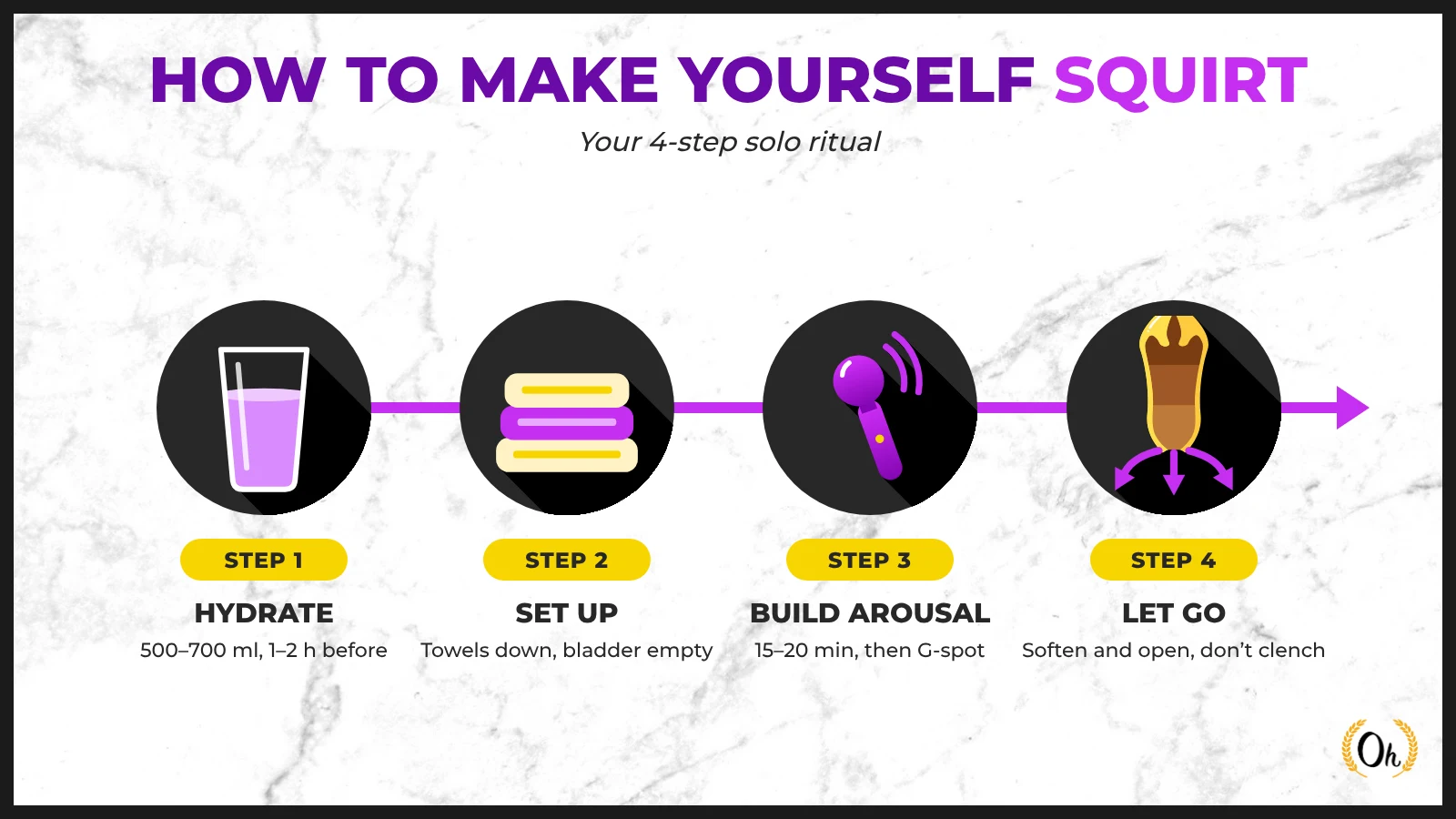
When you’re ready to bring your training into a solo session, follow this framework:
1. Hydrate (Then Empty Your Bladder)
Since most of the fluid comes from your bladder, hydration genuinely matters.
(We are basically nervous pot plants that need a lot of water!)
Drink about 500–700 ml (16–24 oz) of water 1 to 2 hours before your session. Then empty your bladder right before you begin. Your body will refill it during arousal, so you won’t feel uncomfortably full, but there will be fluid available when the moment comes.
2. Set Up for Total Freedom
For a lot of women, the fear of making a mess or “wetting the bed” is a huge thing holding them back.
- Lay down a waterproof blanket or a couple of thick bath towels.
- Get rid of time limits and distractions. Taking the pressure off the outcome is what allows your muscles to truly let go.
3. Build Arousal, Then Find the G-Spot
Like we always say, DON’T RUSH! Especially not when it comes to internal pressure.
Spend 15–20 minutes (think of it as a starting point, not a stopwatch) building whole-body arousal with clitoral stimulation, warm lube or a vibrator (our guide to using a vibrator has plenty of ideas). Once you’re fully aroused, add internal stimulation:
- Insert one or two lubricated fingers (or a curved G-spot toy) palm-up into the vagina.
- Make a steady, rhythmic “come hither” motion against the front wall (toward your belly button).
- Find the slightly textured, spongy area (the G-spot) and apply consistent, firm, rhythmic pressure.
4. Let Go at the Threshold
As the stimulation builds, you’ll feel a warm, growing fullness in your pelvis, quickly followed by what feels like an urgent need to pee.
This is the exact threshold.
Instead of pulling away or tightening up:
- Keep the rhythmic G-spot pressure steady.
- Take a deep breath, soften your belly and do Exercise #4, the Open Release.
- Exhale and let your pelvic floor open into the sensation, without forcing anything.
- Let your muscles unlock completely and let the release happen, without judgment.
Afterwards, pee and freshen up. Clean hands, clean toys and plenty of lube help keep urinary infections away.
And if nothing comes out the first (or tenth) time? That’s normal. Many women squirt only sometimes, and some never do, while still having incredible orgasms. Treat it as exploration, not a test.
Troubleshooting Common Squirting Roadblocks
|
Common issue |
What’s going on |
The fix |
|---|---|---|
|
“I feel like I need to pee, so I stop.” |
The urge to pee and the build-up to squirting feel almost identical, because they involve the same area. |
Remind yourself that the “need to pee” feeling is part of the process. You emptied your bladder beforehand and your towels are down, so lean into the sensation. |
|
“I squeeze tight when I get close, but nothing comes out.” |
Too much squeezing and not enough releasing: your pelvic floor is holding everything in. |
Shift your practice toward Exercise #1 (Reverse Kegel) and Exercise #4 (Open Release) to train letting go while aroused. |
|
“My hand gets tired before I get there.” |
Not enough consistent pressure or leverage. |
Switch to a curved G-spot vibrator for steady, low-effort pressure against the front wall. |
Frequently Asked Questions About Squirting
Is squirting just pee?
Mostly, yes: the fluid comes from your bladder and is chemically very close to urine (some studies find it a little more diluted), often with a little Skene’s gland fluid mixed in. It’s a normal part of some people’s arousal response, not a bladder problem.
Is squirting the same as female ejaculation?
Not quite. Female ejaculation is a small amount of milky fluid from the Skene’s glands. Squirting is a larger gush of mostly bladder fluid. Some women experience one, some both, some neither.
Can every woman squirt?
Not necessarily, and that’s fine! Squirting isn’t a measure of how good your orgasms are. Training your pelvic floor and learning to relax at the right moment can increase your chances, but there are no guarantees.
Why can’t I squirt?
Some of the most common culprits are clenching at the crucial moment, not enough arousal or time, a pelvic floor that’s too tight to release, or simply nerves about making a mess. The Reverse Kegel and the Open Release target exactly these.
Is leaking during sex the same as squirting?
Not always. If you leak urine during sex without much arousal, or at other times too (when you cough, laugh or exercise), mention it to a doctor or pelvic floor physio. That’s worth getting checked.
How do I make myself squirt for the first time?
Hydrate, empty your bladder, put down towels, build arousal for around 15–20 minutes, then use steady “come hither” pressure on the G-spot andsoften and let go when you feel the urge to pee, instead of clenching.
Supercharge Your Pelvic Journey with Goh!ddess
Squirting isn’t a genetic secret. (Thank God!)
It’s closely connected to things you can train: muscle control, body awareness, and knowing your own anatomy.
Practise these six exercises consistently and you’ll build a pelvic floor that can squeeze AND let go, which means more control, more intense orgasms, and a better chance of experiencing squirting for yourself.
Ready to go beyond the basics and master the complete art of vaginal gymnastics?
Check out our all-encompassing Oh!lympus Program (yes, we linked it twice, because it really is THAT good) and dive into The Goh!ddess Method to discover over 27 advanced Pompoir movements designed to transform your sex life.
This article is for education, not medical advice. If you have pelvic pain, pain with penetration or trouble emptying your bladder, see a pelvic floor physiotherapist before training.
Ready to become the ultimate sex goddess?
Get our step-by-step, fully animated Pompoir course.
Stay connected with news and updates!
We hate SPAM. We will never sell your information, for any reason.
