

Vaginal Dryness Natural Remedies: How to Increase Lubrication Naturally and Reclaim Your Pleasure
Oct 12, 2026Have you ever noticed an uncomfortable tightness in your vagina?
Or an unexpected friction during intimacy?
Maybe a persistent, nagging itch down below?
If so, we need to get one thing clear right away: you are NOT broken.
You aren’t “drying up” permanently.
And you most definitely aren’t alone.
Vaginal dryness is one of those frustratingly taboo topics that women tend to endure in quiet exasperation.
We talk endlessly about skin hydration (there are SO many ads for it), glass-skin serums, and drinking two liters of water a day for our face. Yet we rarely give that same moisture-consciousness to our most sacred organ.
Whether it’s caused by postpartum hormone shifts, stress, birth control, medication, or the natural ebb and flow of perimenopause and menopause, vaginal dryness can suddenly turn sex from a sublime experience into a nerve-wracking one.
At Gohddess, we believe every woman deserves a juicy, vibrant, and incredibly pleasurable intimate life at every stage of her journey. (It’s literally why we teach Pompoir.)
Your vagina is a self-lubricating, highly responsive ecosystem. When dryness shows up, it’s simply a signal from your body asking for a little extra nourishment, better blood flow, and some targeted care.
When you’re tired, you sleep. So it makes sense that when you’re dry, you need to moisturize.
In this post we’re going to:
- Explore what actually causes vaginal dryness
- Share the natural remedies for vaginal dryness that have real science behind them
- Show you how to increase vaginal lubrication naturally, from the inside out
|
Quick answer: The most effective natural remedies for vaginal dryness are hyaluronic acid suppositories, pelvic floor training like Pompoir to boost blood flow, sea buckthorn oil supplements, healthy fats in your diet, plenty of water, longer and more relaxed arousal, and cutting out irritants like glycerin lubes, scented soaps and douching. |
What Causes Vaginal Dryness?
To fix dryness naturally, we first need to understand where your natural moisture comes from.
Vaginal lubrication isn’t just liquid sweat. Quite the contrary! It’s a sophisticated fluid made in two main ways:
- Bartholin’s and Skene’s glands: Small glands near the vaginal entrance and urethra that release fluid during arousal to reduce friction at the entrance (Kamaya & Wong-You-Cheong, 2016).
- Vaginal transudate: Most of your internal moisture is a plasma-like fluid that seeps through the vaginal walls when blood flow increases (Butina, 2019).
When your pelvic tissues are healthy, well supplied with blood, and supported by good estrogen levels, the vaginal walls stay thick, elastic, and naturally lubricated.
But when estrogen drops or blood flow slows down, the vaginal walls can thin out (known medically as vaginal atrophy or genitourinary syndrome of menopause), and fluid production drops with them (Mayo Clinic, 2025).
Common Triggers of Vaginal Dryness
- Hormonal transitions: Perimenopause, menopause, postpartum recovery, and breastfeeding all lower estrogen levels.
- Hormonal contraceptives: Some birth control pills and hormonal IUDs can dampen your natural hormone peaks, which affects lubrication for some women.
- Medications: Antihistamines and cold medicines, some antidepressants, and anti-estrogen drugs used in breast cancer treatment can all dry things out (Cleveland Clinic). If your dryness started with a new prescription, that’s a clue!
- Chronic stress: Stress puts your body into fight-or-flight mode, which sends blood toward your big muscles and away from “non-essential” areas like your pelvis.
- A tight pelvic floor: Muscles that are always clenched (hypertonic) can make it harder for blood to circulate freely through the pelvic area, and harder for you to relax into arousal.
- Smoking: It reduces blood flow everywhere, including down there.
- Chemical irritants: Harsh body washes, scented soaps, perfumed laundry detergents, and bubble baths can irritate delicate tissue and upset your natural microbiome. (Unfortunately, the old wives’ tales were right on this one.)
Natural Remedies for Vaginal Dryness: What Actually Works
Here’s our science-backed lineup, starting with our favorite.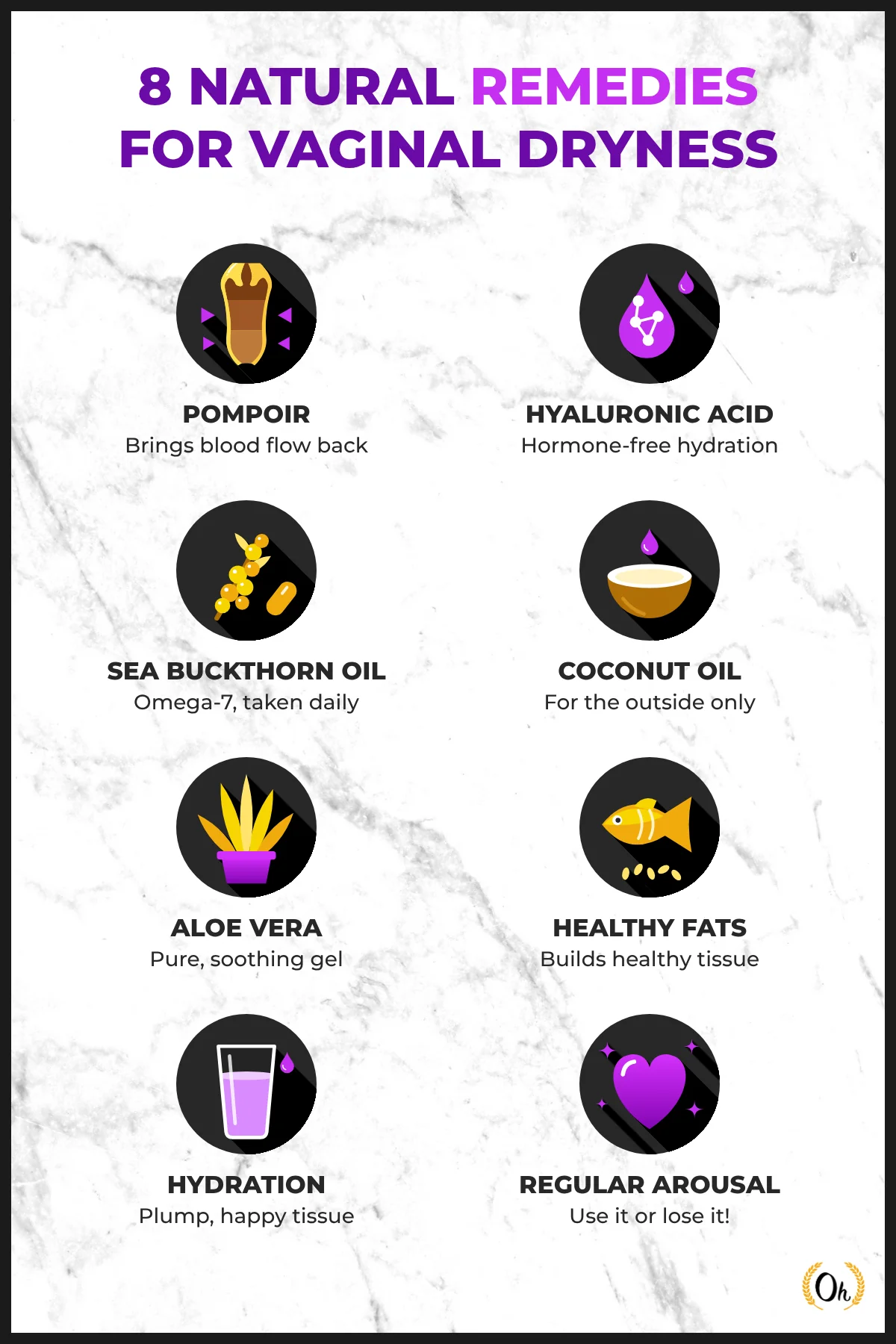
1. Pompoir: Pelvic Floor Training for Blood Flow
When women think of pelvic floor training, they usually imagine standard, run-of-the-mill Kegel squeezes.
But here’s the thing: standard Kegels focus on squeezing tight. Which, ironically enough, can make an already tense pelvic floor even tenser.
At Gohddess, we teach Pompoir: the ancient art of conscious vaginal muscle movement, isolation, and (just as importantly) release.
(In our opinion, it’s definitely the best place to start.)
Here’s why it works. Research on exercising muscles shows that when a muscle contracts, blood flow to that area increases almost immediately (Clifford & Tschakovsky, 2008).
Which basically means that blood goes to the muscles you use.
That localized boost in blood flow has a name: hyperemia.
(We know, it sounds like a supermarket in a foreign country.)
And remember, blood flow is exactly what your vaginal walls need to produce that plasma-like lubrication. So when you work your pelvic floor in deliberate patterns, like the Milking Technique or the reverse Kegel, you’re sending fresh, oxygen-rich blood exactly where you want it.
The research is promising, too: in a small 2018 study, postmenopausal women who did 12 weeks of pelvic floor muscle training had better vaginal secretions, fewer bothersome symptoms, and less impact on their sex lives.
We share the full step-by-step routine further down. Keep reading!
2. Hyaluronic Acid Suppositories
Yes, the same hero ingredient in your face serum! Hyaluronic acid is a molecule your body already makes, and it can hold up to 1,000 times its weight in water.
In clinical trials comparing hyaluronic acid suppositories with low-dose estrogen cream, hyaluronic acid performed impressively at relieving dryness, itching, and painful sex, without any hormones (Jafarzade, 2024).
3. Sea Buckthorn Oil (Hippophae rhamnoides)
A little orange berry with big benefits. Sea buckthorn is rich in rare omega-7 fatty acids.
In a randomized, placebo-controlled study of 116 postmenopausal women, taking 3 g of sea buckthorn oil by mouth every day for three months improved the health of the vaginal lining compared with placebo (Larmo et al., 2014). This one is a supplement, so take it with food, not on your vulva!
4. Coconut Oil and Vitamin E (for the Outside)
Organic, cold-pressed coconut oil and vitamin E oil are lovely for soothing dry, irritated external tissue like the labia and vulva. Keep them on the outside, since oils can upset the delicate balance inside the vagina.
(Note: oil breaks down latex, so don’t use it with latex condoms!)
Vitamin E vaginal suppositories are another option. Small studies suggest they can help with dryness, but check with your doctor before using anything internally.
5. Pure Aloe Vera Gel
Cooling and soothing for external irritation. Make sure it’s 100% pure, with no alcohol, fragrance, or added colors. (That bright green gel from the sunburn aisle is a no!)
6. Eat Your Healthy Fats
Healthy tissue starts on the inside. Your cell membranes are literally built from fats, so give your body the good ones:
- Omega-3s: Wild salmon, sardines, walnuts, chia, and flaxseeds.
- Phytoestrogens: Plant compounds that act like a very weak version of estrogen, found in edamame, tempeh, miso, flaxseeds, sesame, and chickpeas. We’ll be honest: the research on phytoestrogens is mixed (a Cochrane review didn’t find conclusive benefits for menopausal hot flushes). But they’re part of a nourishing diet, and some women find them helpful.
7. Hydrate (Really)
Your mucous membranes need water to stay plump, so if you’re dehydrated, your vagina feels it too. Sip water throughout the day, and lean on water-rich foods like cucumber, watermelon, and citrus. Coconut water counts, too!
8. Regular Arousal and Self-Pleasure
Here’s a remedy nobody complains about! Regular arousal, alone or with a partner, brings blood flow to your vaginal tissues and helps keep them healthy and elastic. Use it or lose it, as they say. (Need inspiration? Our guide to using a vibrator has you covered.)
How to Increase Vaginal Lubrication Naturally
The remedies above nourish your tissues over time. Now let’s talk about how to boost lubrication in the moment, and how to train your body to produce more of it.
The Gohddess Moisture Routine: The Milking Technique
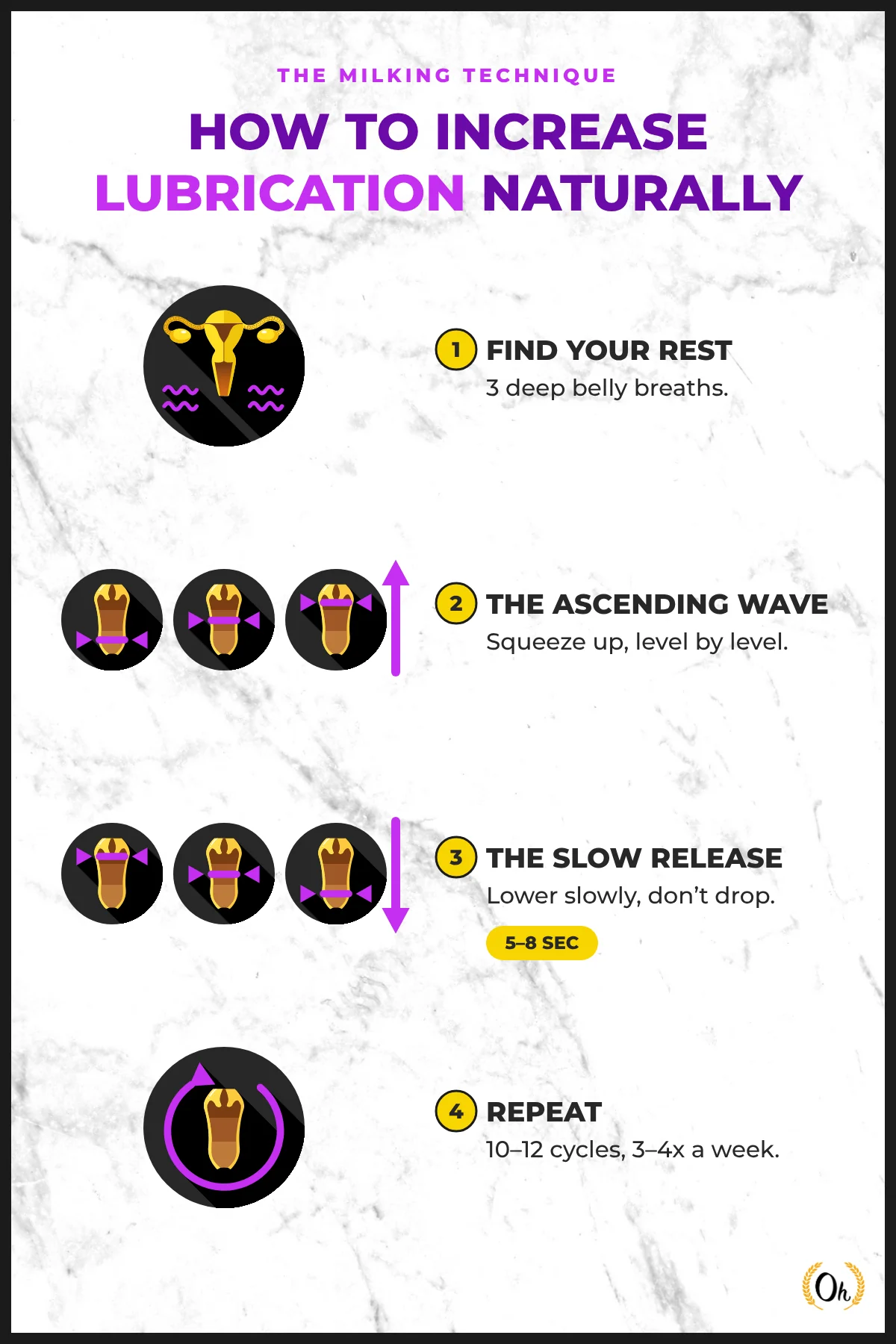
To boost internal blood flow and wake up your natural glands:
- Find your rest: Sit comfortably or lie down with your knees bent. Take three deep belly breaths, letting your belly fully expand on the inhale to relax your pelvic bowl.
- The ascending wave: Inhale, then as you exhale, gently contract your vaginal entrance and slowly move that contraction upward through the middle and deeper canal, like an elevator rising floor by floor.
- The slow release (crucial for dryness!): Instead of letting the muscles drop all at once, lower the contraction floor by floor over 5 to 8 seconds. This slow release softens tight muscle bands and lets blood flow back in freely.
- Repeat: Practice 10 to 12 slow cycles, 3 to 4 times a week.
Slow Down Your Arousal
Sexual arousal isn’t just an emotional event. It’s a full nervous-system and blood-flow chain reaction.
When stress, anxiety, or performance pressure takes over, your sympathetic nervous system (fight-or-flight) kicks in:
- Stress hormones tighten your blood vessels.
- Blood flow to the pelvis drops.
- Your lubrication glands stop getting the “go” signal.
To shift back into your parasympathetic state (think “rest, digest, and lubricate”), give your body more time:
- Extend your foreplay: Move the focus away from rushing to penetration. Spend 20 to 30 minutes on whole-body massage, kissing, breathwork, or sensual exploration with no finish line in mind.
- Breathe 4-7: Inhale for 4 seconds, exhale for 7. Long exhales activate the vagus nerve, slow your heart rate, and help your whole body (pelvic floor included) let go.
Vaginal Moisturizer vs. Lubricant: What’s the Difference?
These two get mixed up ALL the time, so let’s clear it up:
- Vaginal moisturizers (like hyaluronic acid suppositories) are used regularly, every few days, to hydrate the tissue itself. Think of them as your daily face cream.
- Lubricants are used during sex or self-pleasure to reduce friction in the moment. Think of them as your makeup primer.
If you deal with dryness regularly, you’ll probably love having both.
Natural Remedies vs. Conventional Treatments: A Comparison
To help you navigate your options, here’s how natural remedies compare with conventional medical treatment:
|
Remedy / Treatment |
How it works |
Best for |
Good to know |
|---|---|---|---|
|
Pompoir & pelvic floor exercises |
Boosts blood flow to the pelvis and helps tight muscles release |
Long-term restoration, sensation, and muscle control |
Needs consistent practice (3–4x a week) |
|
Hyaluronic acid suppositories |
Draws water into the vaginal tissue and keeps it hydrated |
Fast, hormone-free relief from internal dryness and burning |
A common non-hormonal option; if you’re in cancer treatment, check with your oncologist first |
|
Sea buckthorn oil (omega-7) |
Nourishes mucous membranes from the inside |
General dryness (eyes, mouth, and vagina) |
Taken by mouth; studied over 3 months of daily use |
|
Coconut oil / vitamin E oil |
Creates a protective barrier on the skin |
Soothing external vulvar dryness and chafing |
External use only; not compatible with latex condoms |
|
Estrogen creams (prescription) |
Delivers estrogen directly to the vaginal tissue |
Moderate to severe vaginal atrophy after menopause |
Requires a prescription; not suitable for every medical history |
What to Avoid: Intimate Care Pitfalls
When you’re dealing with dryness, it’s easy to accidentally make things worse with products full of hidden irritants.
And unfortunately, even some products made specifically for intimate care (we won’t name names, we don’t want a lawsuit!) still contain them.
So please strip these out of your routine:
- High-glycerin or propylene glycol lubes: Many commercial lubes are “high osmolality,” which means they can actually pull water out of your vaginal cells and irritate the tissue (Cunha et al., 2014). Look for lubes labeled iso-osmotic or “body-identical.”
- Fragrances and parabens: Synthetic scents are among the most common triggers of irritation and allergic reactions on sensitive vulvar skin.
- Douching and internal washes: Your vagina is a self-cleaning ecosystem! Washing inside strips away your healthy Lactobacillus bacteria, throws off your natural acidic pH (3.8 to 4.5), and leaves the tissue more irritated and dry.
When to See a Doctor
Natural remedies can bring real, life-changing relief. But listening to your body is the most important thing you can do.
Remember, the person who knows your body best is YOU.
So if something feels off, get it checked out!
Talk to a trusted gynecologist or pelvic floor physical therapist if you have:
- Severe or sharp pain during sex that doesn’t improve with lubrication or relaxation
- Unusual or bad-smelling discharge
- Dryness that doesn’t improve after several weeks of hydration, botanical support, and pelvic floor work
- Burning when you pee
- Unexpected spotting when your period isn’t due
- Repeated urinary tract infections
Frequently Asked Questions About Vaginal Dryness
What is the best natural remedy for vaginal dryness?
Hyaluronic acid suppositories have some of the strongest evidence for fast, hormone-free relief. For long-term change, pair them with pelvic floor training like Pompoir to improve blood flow.
How can I increase vaginal lubrication naturally?
Give yourself longer, more relaxed arousal, train your pelvic floor to boost blood flow, stay hydrated, eat healthy fats, and avoid irritants like scented soaps and high-glycerin lubes.
Does drinking water help vaginal dryness?
It helps if you’re dehydrated, since your mucous membranes need water. On its own it’s rarely the full fix, but it’s an easy place to start.
Is coconut oil safe for vaginal dryness?
It’s great for external dryness on the vulva and labia. Keep it outside the vagina, and never use it with latex condoms.
Can stress cause vaginal dryness?
Yes! Stress shifts blood flow away from the pelvis and blocks the nerve signals that trigger lubrication. That’s why relaxation and longer foreplay make such a big difference.
Reclaim Your Juicy, Vibrant Gohddess Self
Vaginal dryness isn’t an inevitable sentence of aging, and it doesn’t have to be permanent.
Pop culture has really run with this idea (making it seem like we’re grapes slowly turning into raisins). But luckily, not everything on the internet is true.
When you understand your pelvic floor, nourish your tissues from the inside, and practice the Pompoir techniques we talked about, you give your body everything it needs to do what it was designed to do: produce rich, natural lubrication.
Your body is designed for pleasure, fluidity, and effortless intimacy.
So give your pelvic bowl the same care and attention you give your face.
Invest in the right products and moisturize using gentle circular motions. (Thanks, every facial cream instruction page ever, for that sentence!)
Be consistent, be patient, and give your vagina the heavenly treatment it deserves. Most women start to notice a difference within a few weeks.
Ready to become the ultimate sex goddess?
Get our step-by-step, fully animated Pompoir course.
Stay connected with news and updates!
We hate SPAM. We will never sell your information, for any reason.
