

The Reverse Kegel (Releasing)
May 01, 2026The antidote to hypertonic pelvic floors, painful sex, and even dryness is here: master the eccentric contraction and open yourself up to new sensations.

Imagine a probe inside of your vagina as you release to display your divine feminine texture.
- Level: Beginner
- Trains: Strength, Control, Pelvic Floor Health
- Prerequisite: Basic Kegel
What is a Reverse Kegel?
If a kegel is lifting up your pelvic floor, a reverse kegel is the exact opposite: the release of that contraction, letting your muscles go back to their natural state.
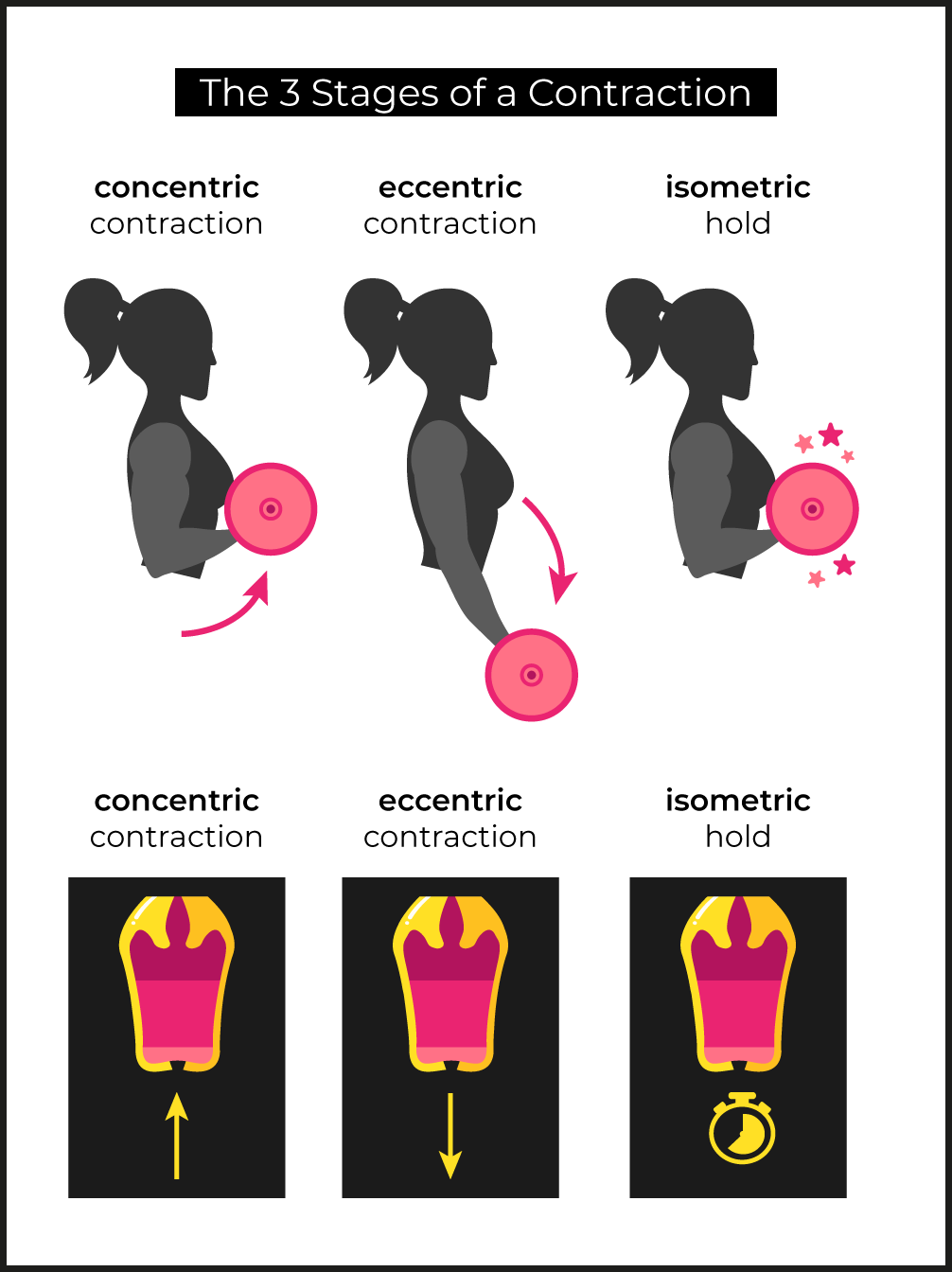
In fitness, this move is called an eccentric contraction. It basically involves paying close attention to the “negative” part of a movement, when the muscles are lengthening back into place after being contracted. For example, you might’ve been told to hinge slowly as you do a deadlift before powerfully pushing your hips forward to raise the weight up. Or to slowly lower down your dumbbell during a bicep curl.
The exact same principle applies here: when you slowly release your pelvic floor muscles back down after a contraction, you’re being especially effective at training strength and control.
This is because you’re actively fighting against gravity (by going slowly rather than letting the contraction release immediately), and because your muscles are capable of producing more force when they’re lengthened.
But in the case of the pelvic floor, it goes much further than that.
A very common issue for women is having a hypertonic pelvic floor. This is a pelvic floor that has overly contracted and is unable to relax. This can lead to chronic pelvic discomfort, painful sex, constipation, and urinary urgency.
This is why we always ask you to check with your physician before starting any form of Pompoir or vaginal gymnastics. Adding advanced exercises on top of an overly tightened pelvic floor would only exacerbate the issue.
That is, except for reverse kegels.
Learning how to release properly is exactly what doctors suggest when dealing with a hypertonic pelvic floor (assuming the issue is not severe enough that they have to manually release the muscles for you).
But reverse kegels are not just for dealing with (or preventing) hypertonicity. And they’re also not just phenomenal at building strength and control.
They are, in fact, an extremely pleasurable skill to perform in bed (see How to Use Reverse Kegels During Sex).
Should I Push Out With My Pelvic Floor?
Short answer: No, reverse kegels should never involve pushing out your pelvic floor
Longer answer: There is a very subtle distinction between an eccentric contraction and a “pushing out” motion, and it is crucial that you understand it before you start doing reverse kegels.
A release (or a reverse kegel) is passive and controlled. You contract your pelvic floor, and then you slowly, deliberately let it descend back to its natural resting position. You’re essentially challenging your muscles by acting as resistance here, instead of aiding them in their downward trajectory by forcing them down.
This movement stops the moment your muscles return to neutral. Your abdomen stays completely relaxed throughout – this move is solely happening in your pelvic floor.
Pushing out is active and downward. It involves bearing down with your abdominal muscles, creating intra-abdominal pressure that forces the pelvic floor below its natural resting state. This is the same action as straining during a bowel movement, or the bearing-down phase of childbirth. Done repeatedly and outside of those specific contexts, it puts chronic downward pressure on your pelvic floor and can contribute to prolapse and worsening incontinence over time.
It’s the difference between slowly lowering a weight down to the floor rather than actively slamming it down.
As you develop body awareness through consistent practice, this distinction will become instinctive. But in the early stages, a useful cue is this: When you feel the controlled descent end and there's no more 'lowering' left, stop. That's your neutral resting position.
TL;DR: if your abs are involved, you've gone too far.
This is an image from our book, The Gohddess Method. Available for paperback and kindle on Amazon.
How To You Use Reverse Kegels During Sex?
The reverse kegel is the most underestimated of the foundational Pompoir exercises, not just for pelvic floor health, but as a deliberate sexual skill in its own right.
Where a kegel says "I'm pulling you in" and a long contraction says "I'm not letting go," a reverse kegel says something different entirely: "I'm opening up for you."
But let’s expand, because there are some very specific and very powerful applications for using this move in the bedroom.
For natural lubrication. If you find yourself dry during sex — whether from nerves, stress, hormonal shifts, or simply needing more warm-up time — a controlled reverse kegel can help redistribute existing lubrication to the surface of the vaginal walls. When you release pelvic floor tension, the vaginal canal opens slightly and natural lubrication that's already present deeper in the tissue becomes more accessible.
You’re not generating new lubrication, you’re releasing what's already there by removing the muscular tension that was holding it in place. A few slow, deliberate releases at the start of sex or whenever you need them can make a meaningful difference without interrupting the moment.
You’ll be surprised at how quickly things can get very, very wet when you remove resistance.
P.S.: This pelvic floor release also plays a direct role in squirting. The ability to fully let go consciously is one of the key factors that makes it possible. If you're curious, we go deep on the mechanics in our How to Squirt guide.
For divine-like texture. You’ll truly feel this benefit once you have a couple of weeks of consistent Pompoir training under your belt. A well-trained pelvic floor develops definition: the vaginal rugae (the natural ridges and folds of the vaginal walls) become more pronounced, and the muscles themselves develop contours that an untrained pelvic floor doesn't have.
When you perform a slow eccentric release during penetration (especially timed to match your partner's thrust – trust me on this!), you put that texture on display. Rather than passive accommodation, you're creating active resistance: so when your partner (or a toy) goes in, you feel a new level of delicious friction inside of you.
This is one of the more quietly extraordinary things a trained pelvic floor can do, and it's almost impossible to describe to someone who hasn't experienced it.
As a palette cleanser between skills. Once you begin combining multiple Pompoir skills in sequence — a squeeze followed by the milking technique, or a whip followed by some fast, deep, pulses — the reverse kegel becomes an essential reset between movements. Releasing fully between skills serves two purposes: it maintains pelvic floor health by ensuring you never stack contractions without conscious release, and it creates a clean starting point for the next skill. This allows you to fully relax into the rhythm of sex and let your previous choreography linger before powerfully beginning your next one, like a musician rejoicing in the applause between songs.
What Are The Best Reverse Kegel Variations?
What Are The Most Common Reverse Kegel Mistakes?
Pushing out instead of releasing. As covered in Should I Push Out With My Pelvic Floor, the most important distinction in this exercise is between a controlled eccentric release and an active bearing-down motion. If your abs engage at any point during the release, you’ve gone too far. The reverse kegel happens entirely in your pelvic floor, with your abdomen staying passive throughout.
Skipping the contraction first. A reverse kegel is not a standalone movement – it's the second half of a complete motion. The eccentric release that happens after the concentric contraction. Some women try to perform reverse kegels without having contracted first, which means they're either doing nothing at all or sliding into a bearing-down motion without realizing it. Always start from a full contraction. Lift first, and then release slowly.
Overdoing them. Because eccentric contractions generate more mechanical tension than concentric ones, they also produce more muscle soreness. This is the same reason your legs are more sore after a slow, controlled descent on a squat than after the upward push. This means reverse kegels should not be practiced at full intensity every day.
Here’s the thing: you should still release every time you contract. This is non-negotiable for pelvic floor health and the natural completion of the full movement.
But when it comes to deliberately slow, trained eccentric releases, limit them to a few sessions per week, as they can be quite challenging for your muscles. If you find your pelvic floor feeling sore or fatigued in the days following reverse kegel training, that's your signal to reduce frequency before increasing it again.
FInally, a note on breathing: some women associate contracting with inhaling and releasing with exhaling, and while this isn't necessarily harmful, it’s not ideal. You either want to do the opposite (inhale as you release and exhale as you contract, as explained in our Pelvic Floor Health Guide), or simply breathe naturally throughout both phases.
Who Should Do Reverse Kegels?
Almost every woman can benefit from practicing reverse kegels. And if you’re already performing concentric contractions and isometric contractions, they are a must.
While other Pompoir exercises are not recommended for women with hypertonic pelvic floors, reverse kegels are actually the primary tool for addressing hypertonicity. Learning to release consciously is exactly what pelvic floor physiotherapists recommend for women experiencing pelvic pain, painful intercourse, or vaginismus.
Beyond pelvic floor health, reverse kegels are particularly valuable for women who experience dryness during sex, who unconsciously hold pelvic floor tension, or who want to advance in their vaginal gymnastics journey sustainably. The eccentric release is a direct prerequisite for more complex Pompoir skills like the Rubbing Technique, which requires the ability to release one side of the pelvic floor while contracting the other.
For everyone else: get the green light from your physician, master your basic kegel first, and add slow reverse kegels to your training as soon as you're ready. Your vag will certainly thank you for it.
If you're ready to train your reverse kegels alongside every other vaginal gymnastics skill with step-by-step guidance, The Ohlympus Program covers every exercise in full detail.
Ready to become the ultimate sex goddess?
Get our step-by-step, fully animated Pompoir course.
Stay connected with news and updates!
We hate SPAM. We will never sell your information, for any reason.
