

The Long Contraction (Holding)
Apr 24, 2026If you’ve ever wondered “why can’t I hold a kegel?” this one’s for you. The kegel hold exercise builds endurance and sustained stimulation.

Imagine a probe inside your vagina as you hold your contraction.
- Level: Beginner
- Trains: Strength, Control, Endurance
- Prerequisite: A non-hypertonic pelvic floor + Basic Kegel
What is a Kegel Hold?
A kegel hold, also called an isometric or long contraction (or simply “holding”) involves a sustained pelvic floor lift. This beginner-friendly exercise is a variation of the standard kegel that directly targets Type I muscle fibers, which make up the majority of your pelvic floor muscles, and are directly responsible for your resting pelvic floor muscle tone.
Building this endurance allows your pelvic floor to stay engaged without burning out, while at the same time improving your neuromuscular efficiency (your brain’s ability to recruit muscle fibers precisely, hold them at a specific level of contraction, and release them consciously).
And as you can imagine… this is great for sex. You get to maintain that grip pressure for longer, add movement on top of it, and vary the intensity in response to different stimuli. All without tiring out.
Outside of sex, the pelvic floors’ fiber composition tells us something important: it was designed for sustained holding, not just quick contractions. Which makes sense, considering it’s responsible for maintaining our pelvic organs in place, as well as supporting our spine, aiding in childbirth and pregnancy, and of course, enabling sexual function.
You could say training isometric contractions (Type I fibers, making up roughly 70% of the pelvic floor) is arguably more important than training short contractions (Type II fibers, making up roughly 30% of the pelvic floor).
And yet, many women avoid kegel holds entirely.
We believe both types of kegels serve its own unique purpose: short contractions teach you how to activate your pelvic floor, while long contractions teach you how to control it.
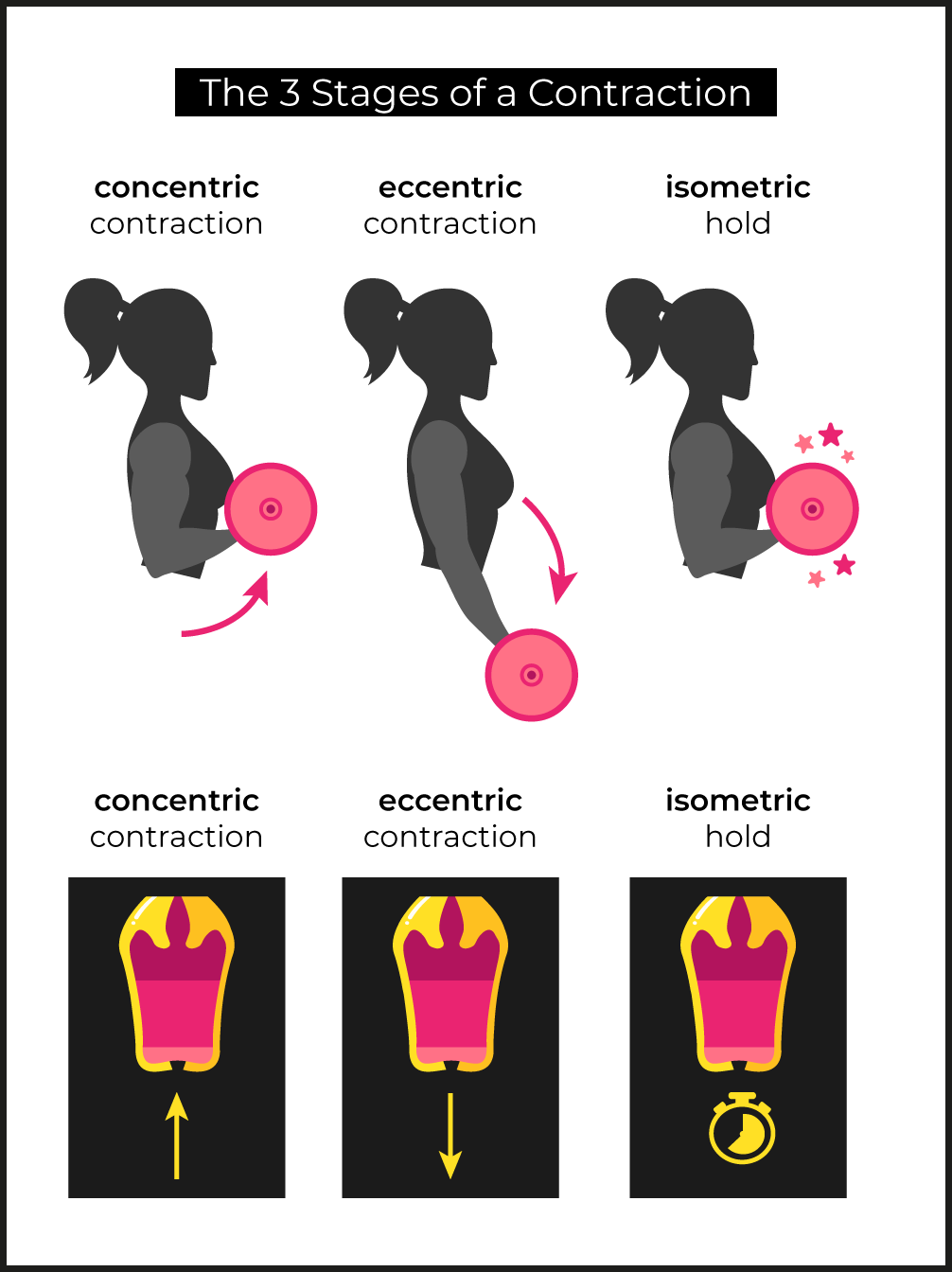
This is an image from our book, The Gohddess Method. Available for paperback and kindle on Amazon.
How Long Should I Hold My Kegels For?
A good starting point is 5 to 10 seconds per hold, for 3 sets of 5 repetitions. As you get stronger, you can work up to holds of 20 to 30 seconds. Beyond that, you're unlikely to get additional benefit.
More time under tension is not always better. What really matters here is the quality of the contraction.
When training isometric holds, you’ll start with a strong contraction that will likely get weaker as the seconds pass. If this happens, relax your pelvic floor muscles, wait 1-2 minutes, and then start your next repetition.
It’s much more effective to hold a strong contraction for 10 seconds than a weak one for 30. And avoiding this “cheating” at the beginning is what will actually get you to hold strong, 30-second contractions much faster.
One thing that surprises many women during their first long holds is muscle shaking. If your pelvic floor trembles during a sustained contraction, this is completely normal and actually a good sign. It means you've recruited your muscle fibers to the point of fatigue and your nervous system is cycling through additional motor units to maintain the effort.
This is exactly the same phenomenon that makes your legs shake during a heavy squat. It means you're working. Breathe through it and hold steady.
But won’t my pelvic floor shaking hurt me?
No. Muscle shaking during an isometric hold is generally not dangerous and cannot cause injury in itself. It's a purely neurological phenomenon, not a structural one. There's no tearing, no overloading of connective tissue, no joint stress involved. It's electrical noise, not mechanical strain.
The pelvic floor especially has very low injury risk from isometric holds because there's no external load and no joint involved. Compare it to something like a loaded barbell hold where shaking could mean a stability risk, and you see that the pelvic floor is in a very safe position.
What does matter, which we’ll cover later on, is that you don’t have a hypertonic pelvic floor before doing isometric holds.
Want to master this exercise + all the other Pompoir skills out there? Get lifetime access to our step-by-step vaginal gymnastics animated course.
How Do You Use Kegel Holds During Sex?
While a basic kegel creates a strong contraction (a momentary pull that both you and your partner feel as a unique sensation), a kegel hold creates something entirely different: sustained tension.
The feeling of being held rather than pulled can feel more intimate and intoxicating, precisely because it doesn't release.
Here are three of the most powerful applications:
To intensify your own sensation. Holding a sustained contraction during penetration increases the friction and pressure you feel against your vaginal walls. This is particularly effective in positions where your partner is relatively still and your bodies are pressed against each other. Slow missionary, the lotus pose, the chairman position.
This is where sustained friction becomes the primary source of sensation rather than movement. Many women find this is how they discover what their pelvic floor actually feels like during sex, because the hold forces a quality of attention and presence that quick contractions don't require.
For edging. Your pelvic floor is one of the primary tension regulators in your arousal cycle. Holding a sustained contraction when you're approaching orgasm creates a specific kind of tension that keeps you at the edge longer than you'd naturally stay there. It requires focus and body awareness, which is also part of what makes it so effective, because that focus pulls you deeper into the experience rather than letting you tip over passively.
For your partner's experience. A sustained hold feels categorically different from a pulse from the receiving end. A long contraction says “I’m not letting go of you”, and the psychological effects that has on a partner’s sexuality is significant.
Hot tip: hold a contraction in a position where your partner can see themselves thrusting in and out of you (i.e. doggy style), and ask them to look down. The visual alone of your vagina grabbing a hold of them is enough to drive someone crazy.
What Are The Best Kegel Hold Variations?
What Are The Most Common Kegel Hold Mistakes?
Holding your breath: This is the most common mistake that women don’t notice they’re doing. When we exert effort (lifting something heavy, bracing for impact, holding a difficult position) our instinct is to also hold our breath. But in pelvic floor training, this creates a problem: it increases intra-abdominal pressure, which pushes down on your pelvic floor from above while you're trying to lift it from below. Basically, you’re putting too much pressure on your core and working against yourself.
The fix is simple but requires conscious attention, especially as the hold gets harder: breathe normally throughout the entire contraction. Inhale and exhale naturally through your nose. If this is too difficult at first, simply hold the contraction for as long as you’re able to breathe normally. Even if it’s just 4 seconds at first. As soon as you feel yourself holding your breath, release, relax, and try again in a couple of minutes. As you continue with your practice, this coordination will become effortless.
Cheating your holds: A long contraction is not just a kegel you forget to release. It's a sustained, consistent effort from second one to second ten (or twenty, or thirty). The most common way women cheat is by starting with a strong contraction and gradually letting it fade without noticing, essentially coasting through the second half of the hold without actually engaging.
The honest version of this exercise is harder than it sounds. If you feel the contraction softening mid-hold, don't extend the time. Shorten the exercise and keep it honest. Quality over quantity.
Who Should Do Kegel Holds?
Anyone who has already built a foundation with basic kegels and wants to take their pelvic floor training to the next level should perform kegel holds. Long contractions will develop the sustained strength, endurance, and fine motor control that basic kegels simply can't build on their own.
Isometric contractions are particularly valuable for women who want to advance in Pompoir, since the sustained awareness and control developed is a direct prerequisite for more complex skills like the Milking Technique and zone isolation exercises.
However, long contractions are not for everyone. If you have a hypertonic pelvic floor (muscles that are already chronically tight and unable to fully relax) kegel holds will reinforce that tension pattern rather than build healthy strength. This can worsen symptoms like pelvic pain, painful intercourse, or vaginismus rather than improve them.
If you experience any of the following, consult a pelvic floor physiotherapist before attempting long contractions: pelvic pain at rest, pain during sex, difficulty inserting a tampon, or a feeling of chronic pressure or heaviness in the pelvic region. A hypertonic pelvic floor needs release work first, not more contraction.
For everyone else: get the green light from your physician, master your basic kegel first, and then add long contractions to your training. Your pelvic floor (and your sex life!) will thank you for it.
If you're ready to train your long contractions, as well as all other Pompoir skill with step-by-step guidance, The Ohlympus Program covers every exercise in full detail.
Ready to become the ultimate sex goddess?
Get our step-by-step, fully animated Pompoir course.
Stay connected with news and updates!
We hate SPAM. We will never sell your information, for any reason.
