

Exercises to Tighten the Vagina
Aug 21, 2022If you’ve read our post on How to Tighten Your Vagina, where we covered the myths and truths of vaginal tightening, then you know that a "loose" vagina isn't really what most people think it is.
You also know that the only scientifically supported, safe, and lasting solution is deliberate pelvic floor training. No cream, gel, laser, or surgery comes close to what consistent exercise can achieve, and unlike those options, exercise works at any age, at any hormonal stage of life, and gets better the longer you do it.
(Not to mention, it brings about extra benefits like more lubrication and better orgasms!)
This article is where we get practical.
But instead of doing what typical kegel guides do and tell you to “squeeze and release” for 3 sets of 10 a couple times a week, we’re going to give you the complete picture of what real pelvic floor training involves, and how you can design a program that develops your muscles in a holistic way so that you’re not just training vaginal tightening, but enhanced sensation, arousal, and orgasms – forever.
This is the framework we use at Gohddess. It's the same framework that underlies our fully animated step-by-step pompoir program, and it's the reason our students consistently report results that go well beyond "tightness". From developing the ability to have cervical orgasms… to achieving skills such as twisting and wringing with their vaginal muscles.
Let’s get nerdy.
Index
- Introduction
- Exercises for Vaginal Tightening: Strength
- Exercises for Vaginal Tightening: Endurance
- Exercises for Vaginal Tightening: Mobility
- Exercises for Vaginal Tightening: Speed
- Exercises for Vaginal Tightening: Health
- Exercises for Vaginal Tightening: Control
- How Often Should I Do These Exercises?
- Is There A Program I Can Follow?
How to Naturally Tighten the Vagina
Here's the thing most pelvic floor content gets wrong: they treat all exercises as interchangeable. “Do kegels”, they say. Squeeze and release, 10 reps, three times a day.
That's like telling someone who wants to get fit to "just move your body". Technically true, but completely missing the point. Fitness has structure, and understanding the purpose behind exercises helps us design a plan that works for our specific goals.
For a pleasure-optimized pelvic floor, there are six distinct components you need to train. Most women, even those who have been doing kegels for years, are training one or two of them and ignoring the rest. That's why at best, their sensation doesn't improve as much as they expected. And at worst, they end up tensing their muscles and developing a hypertonic (and painful) pelvic floor.
Here's what a complete training program looks like.
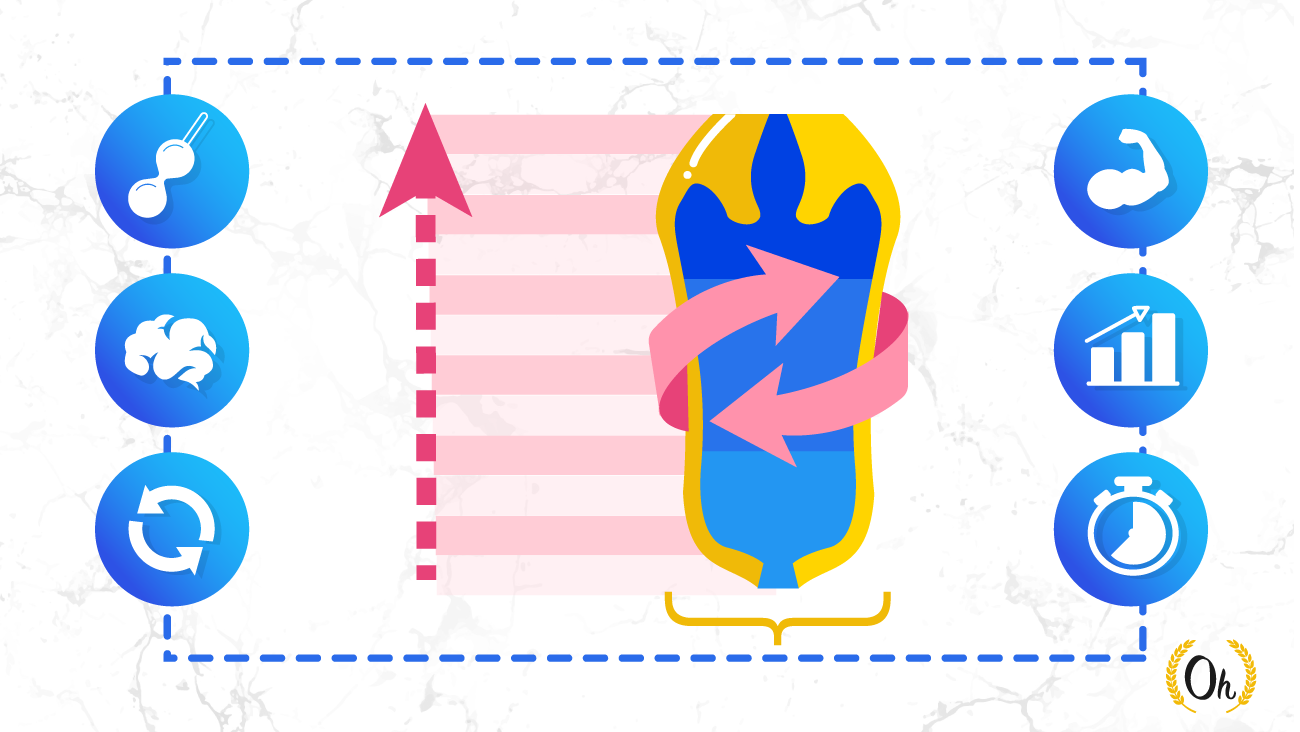
Exercises for Vaginal Tightening: Strength
Strength is the foundation. Without it, nothing else is possible at meaningful intensity.
A great way to built pelvic floor strength is through concentric contractions: the lifting of your muscles, your standard kegel.
You shorten your muscles, you engage them, and you generate force against resistance.
The stronger these muscles become through progressive training, the more physical space they occupy around the vaginal canal, and the stronger their involuntary contractions are during orgasm (ergo, the stronger the orgasms!).
This last point is worth understanding: an orgasm is literally a series of involuntary pelvic floor contractions. Stronger muscles produce stronger contractions. This is the direct mechanical reason why pelvic floor training leads to more intense orgasms, and why it's been demonstrated in research across multiple studies involving hundreds of women.
Strength training for the pelvic floor works exactly like strength training for any other muscle group. You contract against resistance (in this case, gravity and your own bodyweight, since the pelvic floor supports the weight of the organs above it), you progressively increase the difficulty over time, you allow adequate recovery between sessions, and you show up consistently for weeks and months rather than expecting results overnight.
The primary exercise for strength: The Basic Kegel. A full concentric contraction, held for a count, then fully released.
To increase difficulty, you don’t necessarily need to purchase jade eggs or kegel weights (though you absolutely can if you want to). You can also increase difficulty by doing this exercise across different positions, where your pelvic floor is at different levels of stretch (like when you’re on all fours), by slowing down the tempo, by doing more repetitions, or by increasing the time under tension (more on this later).
Either way, no matter how advanced you get in vaginal training, it’s always a good idea to keep doing basic kegels here and there, as it’s the foundation of all other pompoir exercises.
Ready to get started with pelvic floor training? Download our free Pompoir Beginners Guide here.
Exercises for Vaginal Tightening: Endurance
Strength tells you how hard a muscle can contract. Endurance tells you how long it can sustain that contraction without degrading.
They're different muscle adaptations, trained differently, and you need both.
After all, what good is a powerful pelvic floor that fatigues after thirty seconds?
Endurance is built through isometric contractions: holding a contraction at a sustained level of engagement for an extended period, rather than contracting and releasing in repetitions. This targets the slow-twitch Type I muscle fibers that dominate the pelvic floor's composition (approximately 70% of its total fiber makeup). These fibers are built exactly for these sustained, low-to-moderate intensity effort over time.
Here's why this matters practically: without trained endurance, women who can perform impressive contractions at the start of a session find that quality rapidly degrades. Endurance training builds the baseline stamina that makes everything else sustainable at the intensities and durations that matter in real life (aka sex that lasts for longer than a couple of seconds… which we hope is the type you’re having!).
And because the pelvic floor is primarily slow-twitch fibers, training isometric contractions improves your resting pelvic floor tone. That is, the musculature you have at rest, when you’re not actively exercising. A more responsive pelvic floor is not only great for arousal and sexual response, but for your posture, your reaction time, and your balance overall.
The primary exercise for endurance: The Kegel Hold. A full contraction held for an extended period (building from 10 seconds toward 20-30 seconds as capacity develops), focusing on maintaining consistent engagement throughout rather than letting it fade.
The main challenge with this one: you might find yourself unconsciously “cheating”, and thinking you’re holding the contraction for longer when you’ve actually lost the strong pull seconds ago. It’s better to sustain a strong pull for 5 seconds than a weak one for 30.
Exercises for Vaginal Tightening: Mobility
This is the component almost nobody talks about, and it's the one with the most dramatic impact on internal sensation.
Mobility, in athletic training terms, is the ability to actively move through a complete range of motion under muscular control. For the pelvic floor, this means the ability to consciously engage and move through the entire vertical length of the vaginal canal: from the entrance all the way to the deepest point near the cervix, rather than just the two or three levels most women can feel when they first start training.
Here's the uncomfortable reality: most women have significant portions of their vaginal canal that are neurologically unmapped. This means your brain might not have a clear picture of what that region looks like, and by extension, feels like.
Not because the nerve endings aren't there. But because the brain has never been given sufficient reason to develop a detailed, differentiated representation of those zones.
This is where cortical remapping becomes the most important concept in pelvic floor training when it comes to sensation. Every time you deliberately travel through the full length of your vaginal canal (contracting at the entrance, moving that contraction upward level by level, pausing at the deepest point, and slowly releasing back down) you are asking your brain to pay specific attention to zones it has previously registered only as a vague, undifferentiated whole. With repetition, the brain begins allocating more neural resources to those zones. Their representation in the sensory cortex expands. And what previously felt like undifferentiated pressure starts feeling like a detailed, rich, nuanced internal landscape.
It’s kinda like putting on glasses for the first time when you didn't know you needed them. The world was always that detailed. You just couldn't read it yet. Mobility training doesn't create new nerve endings, it teaches your brain to finally read the ones that were always there.
The practical result, reported consistently by women who train this component, is that penetration (of any kind) becomes a completely different experience: much more intense, and with sensation accessible at depths that previously felt like nothing.
The primary exercise for mobility: The Milking Technique. The elevator visualization, traveling through all ten levels of the vaginal canal, both ascending and descending, under deliberate conscious control.
As you train this one, you might shock yourself as you slowly start identifying new vertical levels that previously felt nonexistent. It’s not that you’ve elongated your vagina. You’re simply connecting with all its surrounding muscles more accurately.
Exercises for Vaginal Tightening: Speed
Speed is what turns a strong, mobile, enduring pelvic floor into a dynamic, rhythmic, responsive one.
Speed training specifically recruits fast-twitch Type II muscle fibers. These are the explosive, rapid-response fibers that enable quick, powerful contractions and releases in rapid succession. These are distinct from the slow-twitch fibers that endurance training develops, and they require their own training stimulus. You can't develop speed by doing long slow holds, just as a sprinter can't train for a 100-meter race by jogging leisurely for an hour.
For the pelvic floor specifically, speed training develops three distinct benefits that slower training doesn’t:
Rhythmic capacity: the ability to pulse, contract, and release at varying frequencies, creating internal rhythm during sex that matches and responds to a partner's movement rather than being a static, passive environment. This is the technical foundation of some of Pompoir's most pleasurable applications.
Friction and sensation amplification: rapid contractions and releases create friction against the vaginal walls, which directly amplifies sensation for both partners. The faster and more precise the contractions, the more intense this effect. This is why many women from our program use fast, rhythmic skills for self-pleasure. They’re the best at creating that internal friction that feels so intoxicating.
Vascular response: rapid contractions pump blood into the pelvic region much more aggressively than slow work, creating engorgement of the clitoral complex and vaginal tissue. This is the same physiological mechanism as sexual arousal, triggered through muscular effort rather than psychological stimulation. Another reason why you might need a cold shower after training these, and a great reason to do them at the beginning of sex to get yourself really excited.
The primary exercise for speed: Fast, rhythmic Sucks or Pulses. Brief, sharp contractions or squeezes performed in rapid succession.
Consider performing these while listening to your favorite songs, trying to match the different tempos and melodies. This “vaginal choreography” forces your pelvic floor to adapt to different speeds, and is the foundation of our Pompoir Guitar Hero lessons.
Yes, we literally build vaginal choreographies to your favorite songs for you to follow along inside our Pompoir Program.
Exercises for Vaginal Tightening: Pelvic Floor Health
This section might be the most counterintuitive in the entire article, and it's arguably the most important.
Pelvic floor health is not just about building strength. It's also about the capacity to fully, completely, deliberately release.
Here's why this matters more than most people realize: the pelvic floor, like any heavily trained muscle group, can develop what's called a hypertonic state. This is chronically elevated resting tension that doesn't fully release between contractions.
This isn't strength, it's dysfunction. And it causes real problems, like pelvic pain, painful penetration, reduced sensation, and ironically, a sensation of tightness that is distinctly uncomfortable rather than pleasurable.
Training only concentric strength work without balancing it with eccentric release work is one of the most common ways women develop this problem. Not because kegels are wrong, but because they're only training one direction of a movement that has two equally important phases.
The eccentric release is the controlled, resisted lengthening of the pelvic floor. This is what the reverse kegel trains. It's the slow, deliberate "letting go" after a contraction, where you don't just stop contracting but actively guide the muscle back down through its full range, like lowering a weight slowly rather than dropping it. This trains the eccentric phase of the muscle's movement, which is actually responsible for more adaptation than the concentric phase in many muscle groups.
Eccentric training maintains the pelvic floor's elasticity (its ability to fully lengthen as well as fully shorten) which is what produces the flexible quality of a holistically trained pelvic floor. This matters for comfort, for sensation, and for two very specific reasons:
Natural lubrication redistribution. Natural vaginal lubrication (produced through a process called transudate, where fluid passes through vaginal walls during arousa) is present in the tissue at depth. Chronic pelvic floor tension physically traps it there. Training the deliberate release removes that muscular barrier and allows existing lubrication to redistribute toward the surface, which is why women who train the reverse kegel consistently report dramatically increased wetness. Not from producing more lubrication, but from accessing what was always there.
Another benefit of training the eccentric release and maintaining pelvic floor flexibility is fuller, more comfortable vaginal tenting. Vaginal tenting is the involuntary process where the inner vaginal canal lengthens and expands during arousal while the cervix elevates upward to create space. Tenting is driven by blood flooding the pelvic region, but a hypertonic pelvic floor physically resists this expansion, which is why women with chronically tight pelvic floors often experience discomfort during penetration even when genuinely aroused. Training the deliberate release reduces that resting tension, allowing the body to complete the arousal response it's already trying to have: expanding more fully, accommodating more comfortably, and maintaining that engorged, lubricated quality for longer.
Beyond the eccentric work, a good pelvic floor training program should include muscle stretching after strength and release work. Yogi squats, Child’s Pose, and other hip openers maintain the length and pliability of the adductors, hip flexors, and surrounding connective tissue. The pelvic floor doesn't exist in isolation, it's embedded in a broader network of muscles and fascia, and chronically tight hip flexors or adductors create downstream tension that affects pelvic floor function directly. Regular stretching work supports the pelvic floor's capacity to fully release and fully engage across its complete range.
The primary exercises for pelvic floor health: The Reverse Kegel for the muscular release work, paired with hip flexibility training (deep hip openers, adductor stretches, frog stretch) for the connective tissues.
Exercises for Vaginal Tightening: Control
This is where things get fun. If the previous five components are the foundation of pelvic floor muscle training, mastering control is what really takes your pleasure (and that of your partners’) to another level.
Control is the most neurologically complex dimension of pelvic floor training. It's the ability to selectively recruit specific regions of the pelvic floor independently, to sequence contractions deliberately, to isolate individual walls, and ultimately to "choreograph" internal movement in real time during sex.
This is what Pompoir, or as we like to call it, vaginal gymnastics, is all about. Learning skills like milking, whipping, massaging, locking, even twisting… just with your vaginal muscles.
This level of muscle control requires all five previous components to be sufficiently developed, because you can't isolate what you can't feel, and you can't feel what isn't yet mapped by a mobile, trained nervous system, and you can't map what isn't strong and responsive enough to generate a clear signal.
(Don’t worry, we start with the very foundations both in our book and our animated Pompoir program, and build from there to get you pulsing and twisting away)
Here's what control actually encompasses:
Wall isolation: the ability to move the right wall of the vaginal canal independently of the left, and the anterior (front) wall independently from the posterior (back) to create targeted stimulation of specific erogenous zones.
While you might find this impossible, consider the example of bellydancers. They train their abdominal muscles to shift them in isolation, create waves, and shimmy them rhythmically. The same can be applied to the pelvic floor muscles. Pompoir exercises like rocking, rubbing, and controlling train exactly this ability.
Zone isolation: engaging the entrance, middle, or top of the vaginal canal separately, rather than as a single undifferentiated contraction along its entire length. This is what Pompoir exercises like fluttering, whipping and milking train, and this ability is especially good for increasing sensitivity throughout the vagina.
Sequencing and choreography: combining contractions, holds, releases, pulses, and directional presses in deliberate sequences during sex, creating complex rhythmic patterns that turn technical pelvic floor skill into something that produces genuinely extraordinary experiences for both partners. This is the domain that the ancient Indian text Ananga Ranga was describing when it wrote of a woman who could make her body "act as the hand of the gopala-girl who milks the cow". More than a casual metaphor, it’s a direct description of a woman’s ability to manipulate her pelvic floor muscles with as much precision and variety as a hand can have.
How Often Should I Do These Exercises?
This is one of the questions we get asked most often, and the honest answer is more nuanced than "do 10 kegels three times a day."
The general principle: train like an athlete, not like a student following a rigid checklist.
Different components require different frequencies, different recovery periods, and different intensities. Here's a practical framework:
Strength work (concentric kegels): 3-4 sessions per week at full intensity, with rest days between to allow adaptation. The pelvic floor is muscle tissue and responds to training stress the same way any muscle does. The growth and strengthening happen during recovery, not during the training itself. Daily maximum-intensity kegel sessions without recovery days will exhaust the muscle before it has the chance to adapt.
Endurance work (isometric holds): 2-3 sessions per week, since isometric holds at genuine intensity (where you’re actually holding a strong contraction and your muscles start shaking toward the end of the hold) create significant muscular demand.
Mobility work (milking technique): 2-3 sessions per week, carefully. The milking technique involves an eccentric component (the controlled descent through the canal) that creates more muscular stress than it might seem. Start at 2 sessions per week of 10-15 slow repetitions and progress from there as the movement becomes familiar and comfortable.
Speed work (fast pulses): 3-4 sessions per week is manageable because speed work at pelvic floor intensity is lower in absolute muscular load than heavy strength holds. You can layer this into sessions alongside other components.
Health work (eccentric/reverse kegel): 2-3 sessions a week for eccentric kegels, and every time after you train for pelvic floor stretches. The reason: eccentric releases train the pelvic floor's baseline ability to fully let go, but they can be quite demanding in terms of strength. Stretching daily (or after every pelvic floor training practice) allows you to also prevent hypertonicity, without being muscularly demanding.
Control work (advanced Pompoir exercises): 2-3 sessions per week for specific control drills. Control training is highly neurologically demanding. It requires intense focus and deliberate attention, and doing it when already fatigued from other training components typically produces poor results. Keep control sessions either as standalone work or early in a session before fatigue accumulates.
|
Component |
Frequency |
|
Strength |
3-4x/week |
|
Endurance |
2-3x/week |
|
Mobility |
2-3x/week |
|
Speed |
3-4x/week |
|
Health |
2-3x/week + stretch after every session |
|
Control |
2-3x/week |
The minimum effective protocol for a complete beginner: Three sessions per week covering strength and speed, with a brief eccentric release and pelvic floor stretches at the end, and one advanced control and mobility session per week. Build from there as the foundation develops.
The maximum: Don't train every component at maximum intensity every day. The pelvic floor needs recovery like any other muscle system, and chronic daily overtraining is the most common reason women plateau or develop the soreness and reduced flexibility that signals their nervous system is protecting an overtaxed area.
One consistent signal to listen for: daily soreness in the pelvic floor region, or a feeling of persistent tightness/tension that doesn't release between sessions, means you're accumulating training stress faster than you're recovering from it. Listen to your body, take at least 2 rest days a week, and if the feeling persists, consider speaking with a pelvic floor physician before starting again.
Is There A Step-By-Step Vaginal Tightening Course I Can Follow?
Yes, and it covers all six of the components we've outlined here, in a progressive sequence designed to build each one on top of the last.
The Ohlympus Program is our fully animated, step-by-step pelvic floor and Pompoir training program. It's a complete curriculum that starts with strength and health foundations, progressively introduces endurance and mobility work, adds speed training as the foundational skills solidify, and builds into the full control repertoire of Pompoir.
Everything is animated rather than filmed, which means the instructions are visual and precise in a way that video demonstrations of internal exercises can't be. You can see exactly what's happening at each level of the canal, how each movement should feel from the inside, and what correct form looks like.
You also get lifetime access and lifetime updates, which matters because our understanding of these exercises continues to evolve (we're still discovering new movements with the Gohddess community, and every new discovery gets added to the program).
If you want to work through everything in this article in a structured, progressive system rather than piecing it together yourself, the Ohlympus Program is your all-in-one place to do so.
Ready to become the ultimate sex goddess?
Get our step-by-step, fully animated Pompoir course.
Stay connected with news and updates!
We hate SPAM. We will never sell your information, for any reason.
