
The Ultimate Guide to A-Spot and P-Spot Orgasms
Aug 17, 2026If you’ve ever felt like your sexual map was missing a few hidden continents, you’re not alone.
A lot of articles out there are quite superficial, going on and on about the clitoris and penis friction and that’s their “mind-blowing” advice for good sex.
But tucked deeper inside (pun intended!) the pelvic bowl lies two of the most powerful, transformative pleasure zones anatomy has to offer: the A-Spot (Anterior Fornix Erogenous Zone) and the P-Spot (Prostate).
These are not your everyday, quick-fix erogenous zones.
Getting to them requires intention, an understanding of your pelvic anatomy, and a willingness to explore internal landscapes.
Whether you are looking to unlock deep, full-body vaginal orgasms or tap into the rolling, non-ejaculatory waves of prostate pleasure, this comprehensive guide will give you the anatomical blueprint and practical techniques to get there.
Welcome to deep (😉) internal mapping.
Part 1: The A-Spot (Anterior Fornix Erogenous Zone)
If the G-spot is the popular kid in class, the A-spot is the mysterious, deeply sophisticated older sibling.
Discovered in the 1990s by Malaysian researcher Dr. Chua Chee Ann, the A-spot is celebrated for its ability to produce rapid, intense arousal, cascading full-body orgasms, and significant natural lubrication.
Quick Profile of the A-Spot
- Level: Intermediate to Advanced
- Trains: Deep Vaginal Awareness, Pelvic Floor Relaxation, Somatic Presence
- Prerequisite: High baseline arousal, a relaxed (non-hypertonic) pelvic floor, and plenty of lubrication.
Where is the A-Spot? (A quick anatomy lesson)
The A-spot is located deep on the anterior (front) wall of the vagina, tucked into the space between the cervix and the bladder.
Which unfortunately means it is a little bit harder to find than the G-spot.
But don’t worry, we’re here to help!
If you picture the vagina as a tube ending at the cervix, the cervix hangs down like a small button. The spaces around the cervix are called fornices and the A-spot resides in the anterior fornix. The pocket right above the cervix, facing your belly button.
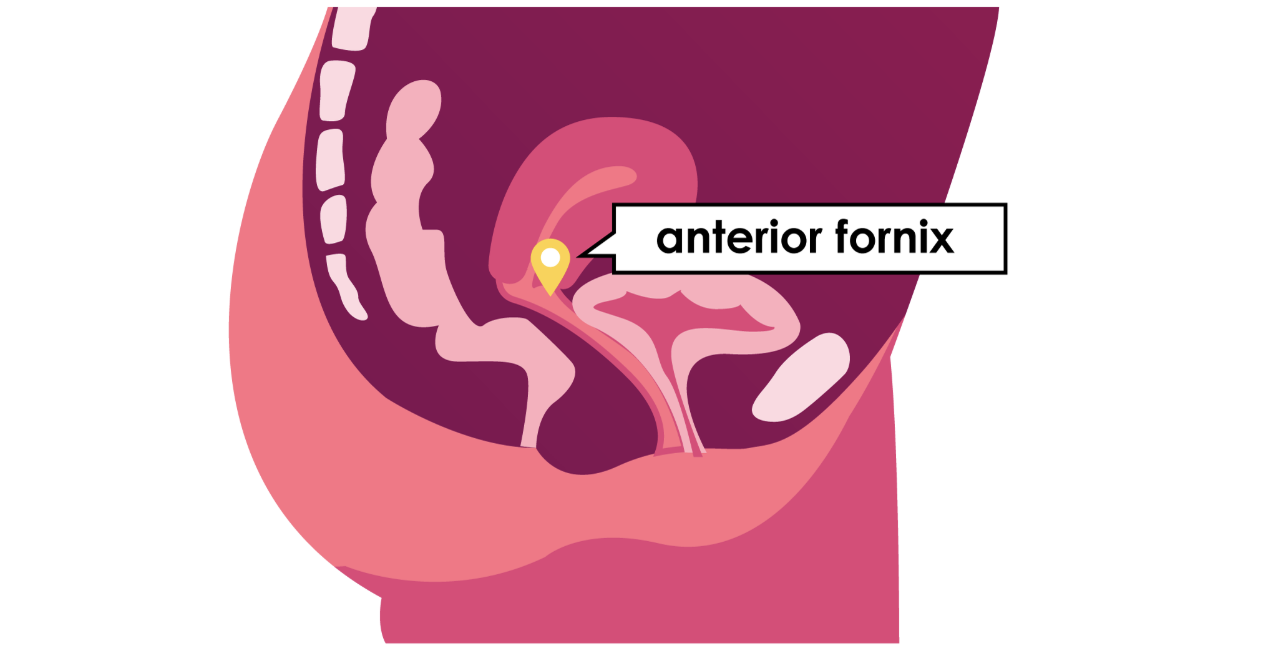
While the G-spot is located about two inches inside the vaginal opening and has a textured, ribbed feel, the A-spot is much deeper. Usually 3 to 5 inches inside and the tissue feels incredibly smooth, and plush, almost like the inside of your cheek. (Making it quite the cheeky experience ;)
The A-Spot Orgasm Experience
Unlike clitoral orgasms, which can feel sharp, localized, and electric, an A-spot orgasm is often described as a deep, visceral, full-body experience.
Because the anterior fornix is rich in nerve endings that share pathways with the vagus nerve and the autonomic nervous system, stimulating this area activates a deep emotional and physical release.
According to Weitkamp and Wehrli, women who experience A-spot orgasms frequently report:
- A profound sensation of openness or "melting."
- Waves of deep, pulsing contractions that travel up into the abdomen.
- Hyper-lubrication: Stimulating the A-spot triggers the Bartholin's and Skene's glands, as well as vaginal transudation, producing a sudden, effortless rush of natural wetness (often nicknamed the "fountain effect").
How to Find and Stimulate the A-Spot
Because the A-spot lives deep in the vaginal canal, you can't just rush into it like a teenage romance during your family beach holiday.
The vaginal canal undergoes a process called vaginal tenting when highly aroused, where the upper portion of the vagina expands and the cervix lifts out of the way.
If you try to get to the A-spot without proper arousal can result in bumping uncomfortably into the cervix.
Which can be a MAJOR turn off.
So let’s see what we can do to get there:
1. Solo Exploration (The "Come Hither" Extended)
- The Set-Up: Spend at least 10-15 minutes warming up your body. Focus on clitoral stimulation or G-spot play first to trigger vaginal tenting.
- The Angle: Insert a long, curved internal toy or your longest fingers (middle and index), palms facing up toward your ceiling (if lying on your back).
- The Reach: Pass the G-spot and slide past the halfway mark of your vaginal canal until you feel the firm, rounded tip of your cervix. Back off just a fraction of an inch and press gently upward against the front vaginal wall into that deep pocket.
- The Motion: Use a steady, rhythmic pressing or bedroom-door-knocking motion. Avoid aggressive scratching; instead, opt for deep, firm, slow pressure.
2. Partnered Positions for A-Spot Devotion
To reach this deep zone during penetration, you need angles that maximize depth while angling the shaft or toy toward the anterior wall.
- The classic Modified Missionary (Pillow Under the Pelvis): Place one or two firm pillows under the receiving partner’s hips. This tilts the pelvis upward, angling the vaginal canal perfectly so that a straight thrust automatically glides along the front wall and lands directly in the anterior fornix.
- The Chairman Position (if only it came with the financial benefits): The penetrating partner sits on a sturdy chair or the edge of the bed. The receiving partner straddles them, facing away. This reverse-cowgirl variation allows the receiving partner to control the depth completely and lean forward slightly, forcing the angle of penetration directly against the deep anterior wall.
- The Lotus Pose (almost like yoga but not quite): Sitting face-to-face, wrapped around each other. This position naturally slows down the movement, replacing frantic thrusting with deep, sustained, grinding pressure right against the A-spot matrix.
Hot Tip for Pelvic Control: As your partner penetrates deeply into the A-spot, try a Pelvic Drop (a conscious relaxation or reverse-kegel). Lengthening your pelvic floor muscles as they enter opens up the deep vaginal vault, allowing them to reach the anterior fornix effortlessly without causing cervical bruising.
Part 2: The P-Spot (The Prostate) - what is it?
The P-spot is one of the most anatomically dense pleasure centers in the human body, often dubbed the "male G-spot,".
Scientists have known for a while that it is important when it comes to ejaculation and reproduction (Marberger 1974) but surprisingly little is known about this when it comes to orgasms.
Unfortunately due to cultural taboos and a general lack of anatomical literacy, it remains largely uncharted territory for millions of individuals with male anatomy.
Quick Profile of the P-Spot
- Level: Intermediate
- Trains: Pelvic Sphincter Control, Somatic Surrender, Mind-Body Connection
- Prerequisite: Complete psychological safety, high-quality silicone or water-based lube, and a total release of pelvic tension.
Where is the P-Spot? (Another quick anatomy lessons)
The prostate is a walnut-sized gland located just below the bladder, wrapping around the urethra.
As we already know, it is quite important when it comes to the male reproductive system, because it is responsible for producing the fluid that carries sperm.
The easiest way to get to it is (yes you guessed it) through the rectum.
The P-spot sits roughly 2 to 3 inches inside the anal canal, located on the anterior wall (meaning the front wall, facing towards the belly button and the base of the penis). When you touch it it feels like a distinct bump or walnut - smooth, round and definitely one of the more important nuts.
The P-Spot Orgasm Experience
A P-spot orgasm is a totally different from a typical penile-focused climax. According to findings by Levin (2017) it has been described as being more pleasurable than an orgasm from penile stimulation, often leaving the person experiencing it shaking or shuddering.
And the best part?
P spot orgasms can last for about 30 minutes.
That’s right, 30 minutes!
Penile orgasms are usually localized, linear, and end quite suddenly with ejaculation and a rapid drop in arousal (the refractory period).
A prostate orgasm, however, is a systemic, neurological event. Because the prostate is surrounded by a dense network of nerves (the prostatic plexus) which connect directly to the pelvic splanchnic nerves, stimulation sends waves of pleasure straight to the core of the nervous system.
According to a case study by Levin, 2017, a P-spot orgasm can be:
- Hands-Free: Achieved entirely without touching the penis.
- Non-Ejaculatory: Yielding intense, full-body climaxes that do not result in immediate ejaculation, allowing for consecutive, multiple orgasms.
- Radiant: Spreading from the perineum outward into the thighs, chest, and lower back, leaving the individual in a state of deep, meditative relaxation.
How to Find and Stimulate the P-Spot
As most people know, anal tissue is highly sensitive but unfortunately NOT self-lubricating.
So if you’re exploring the P-spot, you should be a little bit more methodical and respectful.
Here’s why:
1. Preparation and Hygiene
- Mindset first: The external anal sphincter is a highly reactive muscle. If you feel anxious, guilty, or rushed, it will clamp shut, making exploration uncomfortable. Take a warm bath, practice deep belly breathing, and ensure complete privacy.
- Cleanliness: Empty your bowels before beginning. If it makes you feel more comfortable, use a simple water bulb/enema, though a simple shower wash is usually more than enough. Use gloves or finger cots if you’re using your hands.
- The Lubrication Rule: Don’t use too much lube. Opt for a high-quality, thick water-based or silicone lubricant. Apply it to both the anus and the finger/toy.
2. Step-by-Step Solo P-Spot Mapping
- Step 1 (The Gateway): Lay on your back with your knees bent, or curl on your side in a fetal position. Apply lube to the opening. Gently press a well-lubricated finger against the anus. Do not push inside immediately. Wait for the external sphincter to "give way" and accept the finger naturally.
- Step 2 (The Incline): Insert your finger slowly, angling up and forward toward the front of your body (the direction of your belt buckle).
- Step 3 (The Assessment): Once you are about two knuckles deep, curve your finger slightly in a "come hither" motion. You will feel a smooth, firm, rounded mound. That is the prostate gland.
- Step 4 (The Stroking Technique): Apply gentle, sweeping pressure across the surface of the gland. You can alternate between steady, stationary pressure, light circles, or a soft downward stroking motion (massaging the prostate from top to bottom).
P-SPOT STIMULATION PROTOCOL
|
Steps |
Description |
|
1. EXTERNAL DESENSITIZATION |
Circle the opening with plenty of lube. |
|
2. SPHINCTER RELEASE |
Take a deep breath; insert on the exhale. |
|
3. ANTERIOR SWEEP |
Locate the walnut-sized gland 2 inches in. |
|
4. VARIATION MATRIX |
Alternate steady pressure with light circles. |
3. Partnered P-Spot Magic
If you’re exploring this with a partner (whether via fingers, a specialized prostate massager, or strap-on/penile penetration), communication HAS to be your priority.
- Doggy Style or Spooning: Both positions allow the penetrating partner easy access to the correct angle. Spooning is particularly effective because it keeps both bodies relaxed and limits aggressive, deep thrusting, focusing instead on micro-movements against the front rectal wall.
- The Feedback Loop: The receiving partner should guide the pace. Use simple cues: "More pressure," "Hold it right there," or "Slow down."
Part 3: The Internal Pleasure Matrix
While the A-spot and P-spot exist in different bodies, they share remarkable similarities in how they interact with our nervous system and pelvic anatomy.
|
Feature |
The A-Spot (Anterior Fornix) |
The P-Spot (Prostate) |
|
Anatomical Location |
Deep vaginal canal; anterior wall above cervix. |
Internal rectal canal; anterior wall, 2–3 inches in. |
|
Physical Texture |
Smooth, plush, spongy, soft pocket. |
Smooth, firm, rounded, walnut-sized gland. |
|
Primary Sensation |
Deep abdominal melting, pulsing fullness. |
Visceral, radiating, full-body core heat. |
|
Fluid Response |
Intense, rapid natural lubrication / "fountain effect." |
Pre-ejaculatory clear fluid discharge / non-ejaculatory climax. |
|
Pelvic Key |
Requires vaginal tenting & deep cervical release. |
Requires total external/internal sphincter relaxation. |
Part 4: The Pelvic Floor Connection
So imagine that your pelvic floor muscles,specifically the pubococcygeus (PC) muscle, act as the floorboards for your entire reproductive system. And the unfortunate truth is that you won’t be able to have consistent, deep internal orgasms if your pelvic floor is operating on autopilot.
When it comes to deep spots like the A and P, your pelvic floor training must pivot from simple "gripping" to neuromuscular coordination.
The Dangers of the Hypertonic Pelvic Floor
A lot of people jump straight into internal exploration with a hypertonic pelvic floor, meaning their pelvic muscles are chronically tight, shortened, and unable to fully relax.
We REALLY wouldn’t recommend doing this.
Why?
- If you try to stimulate the A-spot with a tight pelvic floor, penetration will feel shallow, restrictive, or like hitting a wall. It will be really uncomfortable and you could even get a bruised sensation near the cervix.
- If you try to stimulate the P-spot with a tight pelvic floor, the anal sphincters will actively fight the insertion, resulting in pain, micro-tears, or a complete shutdown of pleasure.
How to Use "Pelvic Drops" to Open the Gates
Before attempting deep internal stimulation, practice the Pelvic Drop (also known as a Reverse Kegel).
If you imagine your pelvic floor as an elevator, a standard kegel lifts the elevator to about the 5th floor. A pelvic drop consciously sends the elevator down into the basement, expanding and lengthening the muscles.
- Inhale deeply into your lower abdomen and back, letting your belly expand fully.
- As you inhale, imagine gently pushing your pelvic floor downward and outward.
- Hold that sensation of openness at the bottom of your breath without straining. Exhale naturally, letting the muscle return to its resting state.
During Sex: Perform a pelvic drop exactly at the moment of insertion or deep thrusting. This drops the muscular gate, allowing toys, fingers, or a partner to glide effortlessly past the restrictive outer muscle layers and land perfectly on the A-spot or P-spot matrix.
Part 5: Common Mistakes & How to Fix Them
If you’ve tried finding these spots before and ended up frustrated, numb, or in discomfort, you likely fell into one of these three common traps:
1. The Breath-Hold (The Intra-Abdominal Trap)
- The Mistake: When a toy or finger goes deep, our natural instinct is to brace for impact by holding our breath.
- The Fix: Use the Continuous Exhale Rule. Never allow a finger or toy to advance deeper unless you are actively blowing air out through your mouth or nose.
2. Rushing the Journey (The Lack of Tenting)
- The Mistake: Aiming for the A-spot or P-spot within the first two minutes of foreplay. If the vagina hasn’t tented or the rectal canal hasn't acclimated to the presence of lube, these deep zones are effectively hidden or defended by surrounding tissue.
- The Fix: Dedicate the first 80% of your session to external zones. Maximize clitoral or penile/perineum arousal first. Wait until the body is explicitly asking for deep internal contact before crossing the threshold.
3. Using the Wrong Tools
- The Mistake: Attempting to reach these specific, angled zones with completely straight, short, or rigid implements that can't navigate the natural curves of the pelvic bowl.
- The Fix: Invest in targeted anatomy. For the A-spot, look for longer wands with a gentle, sweeping hook at the end. For the P-spot, use an anatomically curved prostate massager designed specifically to cradle the gland while resting comfortably against the perineum.
The Art of Somatic Surrender: Some last thoughts…
Unlocking the A-spot and P-spot basically comes down to being an exercise in somatic surrender.
What does that mean?
Well, in surface-level friction play you can be distracted and it doesn’t take a lot of concentration. But with deep internal exploration, you have to be fully present and aware of what’s going on.
If your mind is wandering to your grocery list or worrying about how you look, your pelvic floor will mirror that tension, locking away the access keys to these deeper networks of pleasure.
So remember to take your time and listen to your body’s subtle feedback.
You have to treat internal mapping as a deep, ongoing conversation with your own nervous system and not as a goal oriented race to a finish line.. This is pleasure we’re dealing with, not business goals.
Your pelvic floor has incredible depths of pleasure, all it takes is the right map, the right breath, and the patience to explore it honestly.
And if you are still unsure about the steps, don’t worry!
Here's A Program to Guide You Step-by-Step
The Ohlympus Program is our flagship, fully animated, step-by-step training curriculum designed to take you from a complete baseline up to advanced Pompoir mastery.
Because internal movement can be incredibly difficult to conceptualize, our entire system uses high-definition, clear anatomical animations rather than confusing text descriptions or opaque video guides.
You can see precisely how a wave moves, what a proper deep release looks like, and how to accurately engage each individual level of your internal anatomy.
With lifetime access to every update and a supportive global community, it is a definitive roadmap for expanding your somatic awareness and unlocking the full depth of your biological pleasure potential.
Ready to become the ultimate sex goddess?
Get our step-by-step, fully animated Pompoir course.
Stay connected with news and updates!
We hate SPAM. We will never sell your information, for any reason.
